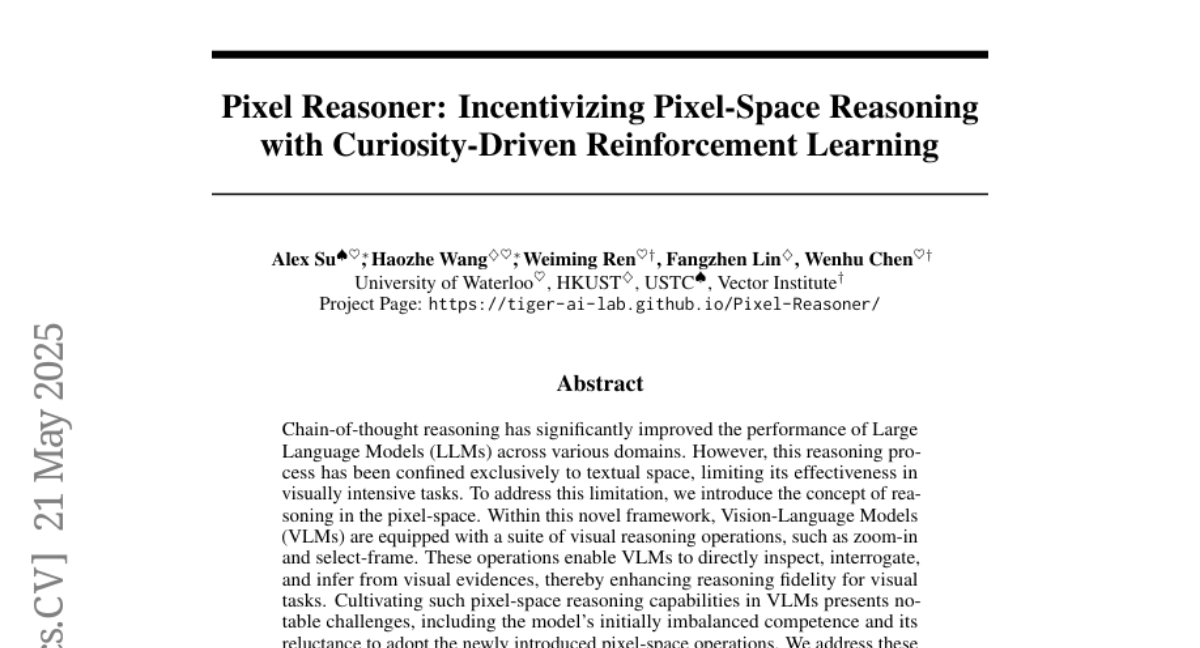
Pixel Reasoner: Incentivizing Pixel-Space Reasoning with Curiosity-Driven Reinforcement Learning
Alex Su, Haozhe Wang, Weimin Ren, Fangzhen Lin, Wenhu Chen
2025-05-23
Summary
This paper talks about Pixel Reasoner, a new way to help AI models that work with both pictures and words get better at understanding images by encouraging them to explore and focus on specific parts of a picture, kind of like how a person might zoom in or pick out important details.
What's the problem?
Vision-language models often miss important visual details because they usually look at the whole image at once, instead of examining specific areas more closely, which can lead to mistakes or less accurate answers.
What's the solution?
The researchers used curiosity-driven reinforcement learning to motivate the AI to actively explore images by zooming in or selecting certain frames, which helps the model pay attention to the most important parts and improves its ability to reason about what it sees.
Why it matters?
This matters because it makes AI much better at understanding and analyzing images, which can help in areas like medical imaging, security, or any place where it's important to notice small but important details.
Abstract
Introducing pixel-space reasoning in Vision-Language Models (VLMs) through visual operations like zoom-in and select-frame enhances their performance on visual tasks.