PixelThink: Towards Efficient Chain-of-Pixel Reasoning
Song Wang, Gongfan Fang, Lingdong Kong, Xiangtai Li, Jianyun Xu, Sheng Yang, Qiang Li, Jianke Zhu, Xinchao Wang
2025-05-29
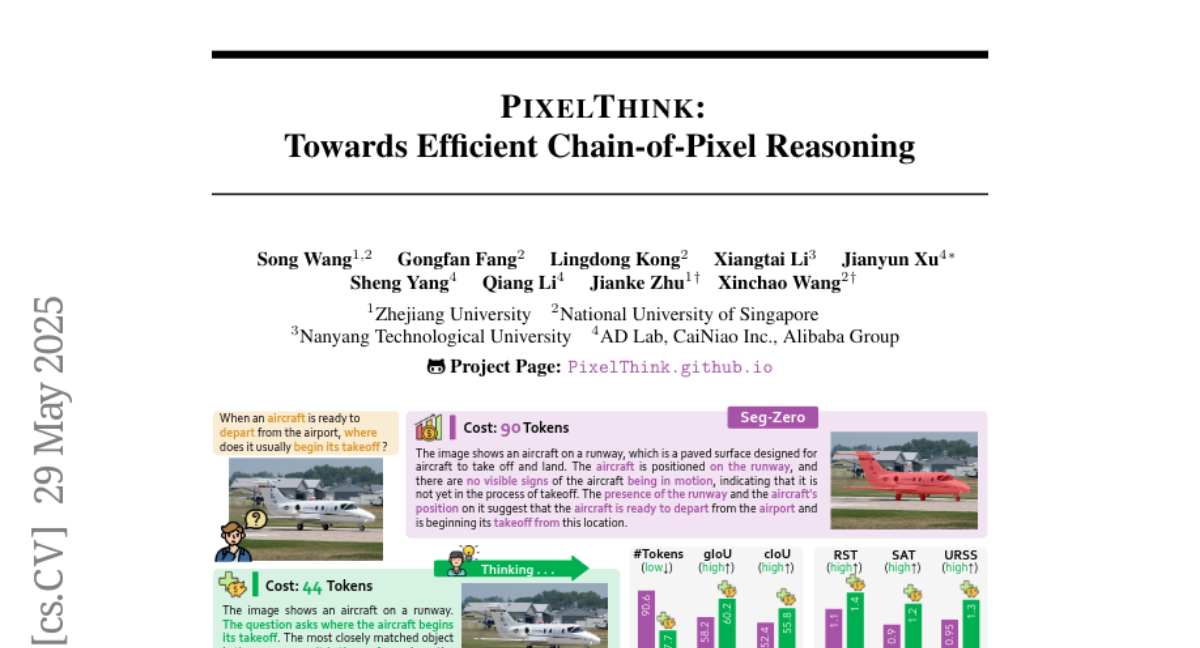
Summary
This paper talks about PixelThink, a new way for computers to better understand and break down images by thinking through them step by step, sort of like solving a puzzle one piece at a time.
What's the problem?
The problem is that when AI tries to analyze images, especially complicated ones, it can waste time on easy parts or get confused by tricky sections. Regular methods don't always know which parts need more attention or how confident the AI should be about its decisions, which can slow things down and make mistakes more likely.
What's the solution?
The researchers improved the process by teaching the AI to pay more attention to parts of the image that are harder or where it's less sure about its answers. They used reinforcement learning, so the AI learns from its successes and failures, focusing its efforts where it matters most and making smarter choices as it goes through each part of the image.
Why it matters?
This is important because it makes computers much better at understanding images quickly and accurately, which can help in areas like medical scans, self-driving cars, and any technology that needs to 'see' and make sense of the world around it.
Abstract
PixelThink enhances reasoning segmentation by integrating task difficulty and model uncertainty in reinforcement learning, improving efficiency and accuracy.