Progressive Rendering Distillation: Adapting Stable Diffusion for Instant Text-to-Mesh Generation without 3D Data
Zhiyuan Ma, Xinyue Liang, Rongyuan Wu, Xiangyu Zhu, Zhen Lei, Lei Zhang
2025-04-01
Summary
This paper discusses a way to quickly create 3D models from text using AI, without needing lots of example 3D models to train on.
What's the problem?
It's hard to train AI to make good 3D models from text because there isn't enough training data available.
What's the solution?
The researchers developed a method called Progressive Rendering Distillation (PRD) that uses existing AI models to help train a new model to create 3D models from text, even without real 3D data.
Why it matters?
This work matters because it makes it easier and faster to create 3D models from text, which can be useful for things like game design and virtual reality.
Abstract
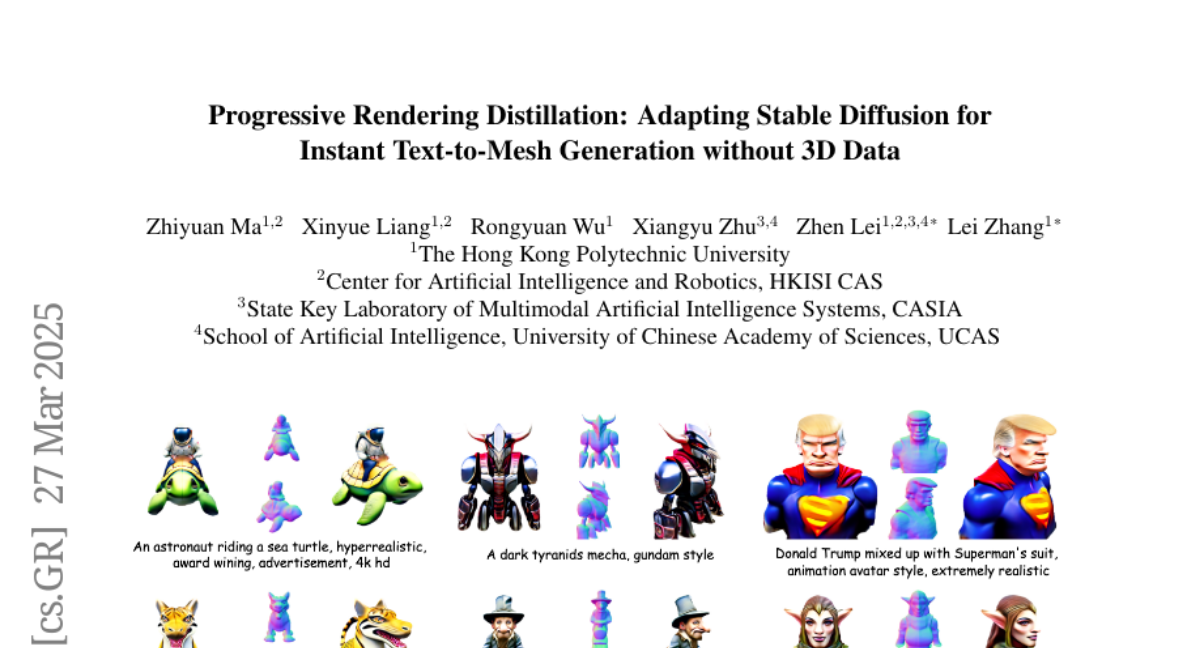
It is highly desirable to obtain a model that can generate high-quality 3D meshes from text prompts in just seconds. While recent attempts have adapted pre-trained text-to-image diffusion models, such as Stable Diffusion (SD), into generators of 3D representations (e.g., Triplane), they often suffer from poor quality due to the lack of sufficient high-quality 3D training data. Aiming at overcoming the data shortage, we propose a novel training scheme, termed as Progressive Rendering Distillation (PRD), eliminating the need for 3D ground-truths by distilling multi-view diffusion models and adapting SD into a native 3D generator. In each iteration of training, PRD uses the U-Net to progressively denoise the latent from random noise for a few steps, and in each step it decodes the denoised latent into 3D output. Multi-view diffusion models, including MVDream and RichDreamer, are used in joint with SD to distill text-consistent textures and geometries into the 3D outputs through score distillation. Since PRD supports training without 3D ground-truths, we can easily scale up the training data and improve generation quality for challenging text prompts with creative concepts. Meanwhile, PRD can accelerate the inference speed of the generation model in just a few steps. With PRD, we train a Triplane generator, namely TriplaneTurbo, which adds only 2.5% trainable parameters to adapt SD for Triplane generation. TriplaneTurbo outperforms previous text-to-3D generators in both efficiency and quality. Specifically, it can produce high-quality 3D meshes in 1.2 seconds and generalize well for challenging text input. The code is available at https://github.com/theEricMa/TriplaneTurbo.