Provably Learning from Language Feedback
Wanqiao Xu, Allen Nie, Ruijie Zheng, Aditya Modi, Adith Swaminathan, Ching-An Cheng
2025-06-17
Summary
This paper talks about a new framework and algorithm that help AI models learn better from language feedback during interactions. Instead of just learning from fixed data, the AI can improve itself by understanding feedback given in natural language during conversations, making the learning process more dynamic and interactive.
What's the problem?
The problem is that current large language models mainly learn from static data examples and have a hard time learning effectively from language feedback during real-world interactions. This makes it difficult for AI to improve by understanding instructions, corrections, or suggestions given to it in natural conversations, limiting how well it can adapt and learn on the fly.
What's the solution?
The solution is the introduction of a formal framework and a no-regret algorithm that allow the AI model to learn from language feedback in an interactive setting. This algorithm ensures that over time, the model’s learning process becomes better and the mistakes it makes decrease steadily, even when feedback is imperfect or noisy, enabling reliable and provable improvement during interaction.
Why it matters?
This matters because it makes AI models much better at learning from the way humans naturally give feedback, which often comes as language comments or instructions. By enabling AI to learn effectively from these real-time interactions, the technology becomes more adaptable, useful, and capable of improving continuously in practical applications such as tutoring, customer support, and conversational assistants.
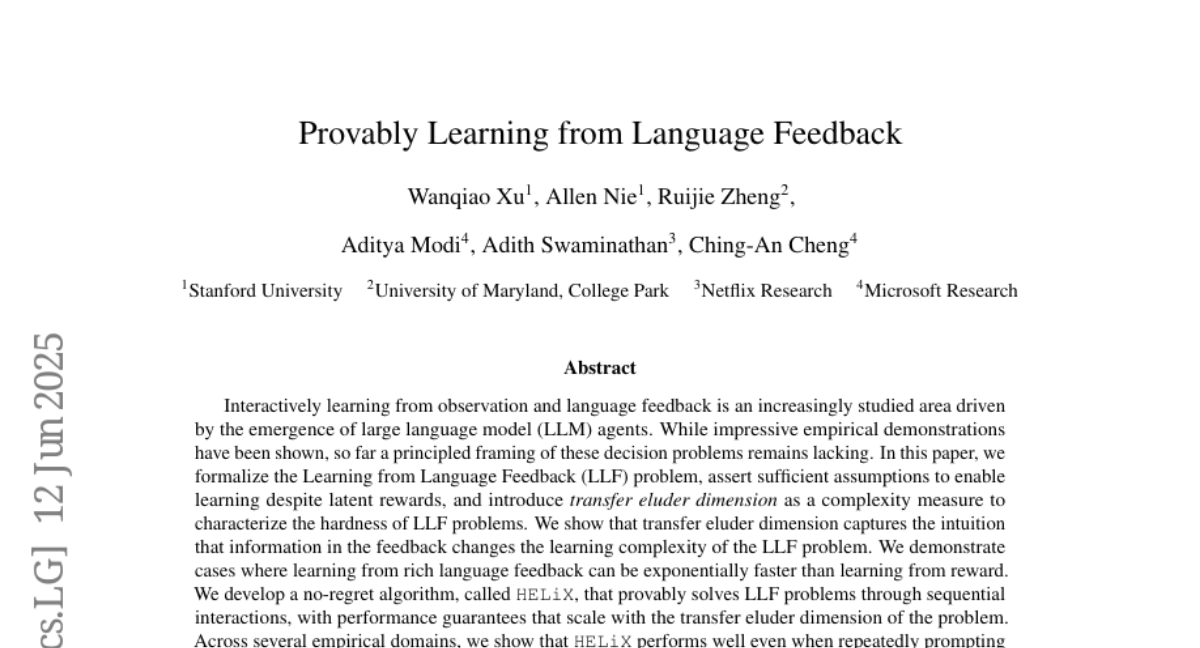
Abstract
A formal framework and no-regret algorithm are introduced for learning from language feedback, addressing challenges in interactive learning with large language models.