PVChat: Personalized Video Chat with One-Shot Learning
Yufei Shi, Weilong Yan, Gang Xu, Yumeng Li, Yuchen Li, Zhenxi Li, Fei Richard Yu, Ming Li, Si Yong Yeo
2025-03-24
Summary
This paper is about making AI video chats that can recognize and remember specific people, even if the AI has only seen them in one video.
What's the problem?
AI that understands videos is good at recognizing general things, like talking or eating, but struggles to identify specific people, which limits its usefulness in areas like healthcare or smart homes.
What's the solution?
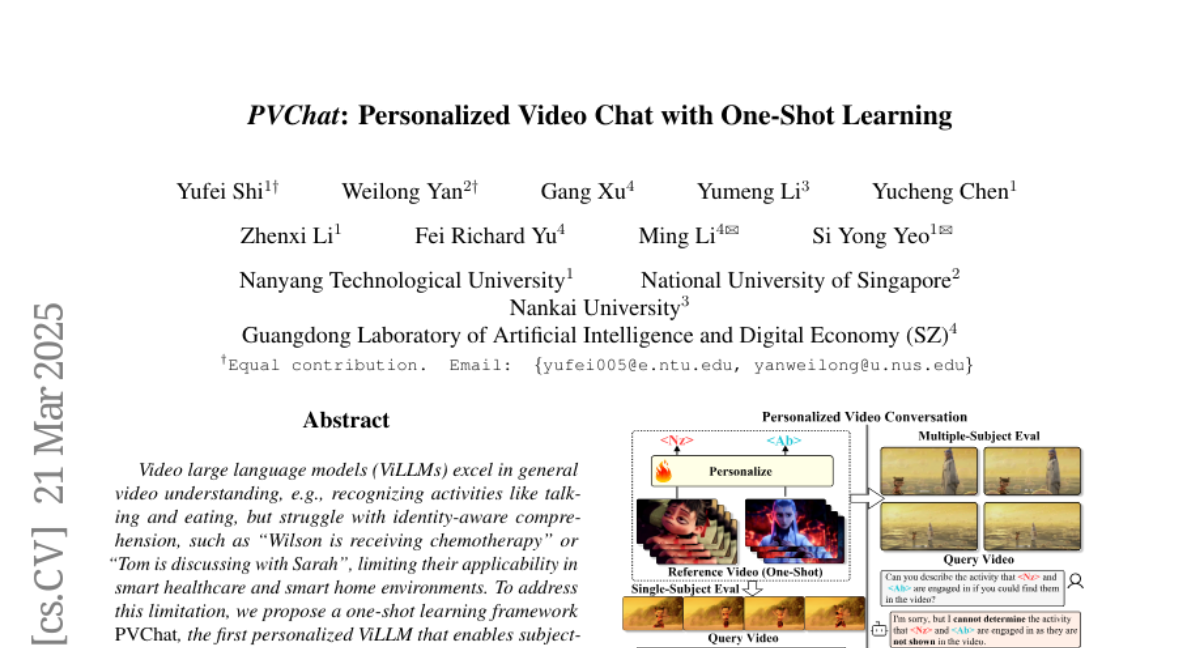
The researchers created a system called PVChat that can learn to recognize people from just one video and then answer questions about them in other videos.
Why it matters?
This work matters because it could lead to AI video systems that are better at understanding and responding to individual people.
Abstract
Video large language models (ViLLMs) excel in general video understanding, e.g., recognizing activities like talking and eating, but struggle with identity-aware comprehension, such as "Wilson is receiving chemotherapy" or "Tom is discussing with Sarah", limiting their applicability in smart healthcare and smart home environments. To address this limitation, we propose a one-shot learning framework PVChat, the first personalized ViLLM that enables subject-aware question answering (QA) from a single video for each subject. Our approach optimizes a Mixture-of-Heads (MoH) enhanced ViLLM on a synthetically augmented video-QA dataset, leveraging a progressive image-to-video learning strategy. Specifically, we introduce an automated augmentation pipeline that synthesizes identity-preserving positive samples and retrieves hard negatives from existing video corpora, generating a diverse training dataset with four QA types: existence, appearance, action, and location inquiries. To enhance subject-specific learning, we propose a ReLU Routing MoH attention mechanism, alongside two novel objectives: (1) Smooth Proximity Regularization for progressive learning through exponential distance scaling and (2) Head Activation Enhancement for balanced attention routing. Finally, we adopt a two-stage training strategy, transitioning from image pre-training to video fine-tuning, enabling a gradual learning process from static attributes to dynamic representations. We evaluate PVChat on diverse datasets covering medical scenarios, TV series, anime, and real-world footage, demonstrating its superiority in personalized feature understanding after learning from a single video, compared to state-of-the-art ViLLMs.