R3: Robust Rubric-Agnostic Reward Models
David Anugraha, Zilu Tang, Lester James V. Miranda, Hanyang Zhao, Mohammad Rifqi Farhansyah, Garry Kuwanto, Derry Wijaya, Genta Indra Winata
2025-05-20
Summary
This paper talks about R3, a new way to help AI models better understand and follow what people want, even when there isn’t a strict set of rules or rubrics.
What's the problem?
The problem is that language models often need clear guidelines to know what kind of answers people prefer, but in real life, people’s preferences can be flexible and not always written down as strict rules, which makes it hard for AI to always give satisfying responses.
What's the solution?
To solve this, the researchers created a reward system that doesn’t rely on a single set of rules but can adapt to different preferences and situations. This makes it easier for the AI to learn what people like, explain its choices, and adjust its behavior as needed.
Why it matters?
This matters because it makes AI more useful and trustworthy in real conversations, since it can better match what people want, even when those wants change or aren’t clearly defined.
Abstract
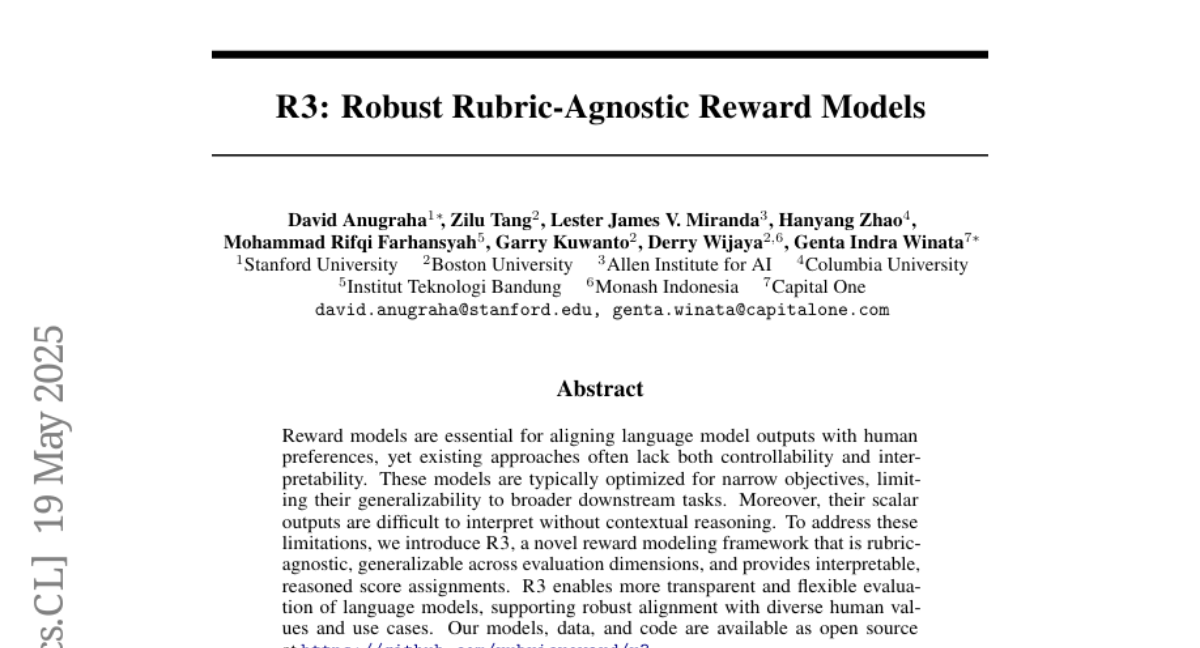
R3 is a novel reward modeling framework that enhances controllability, interpretability, and flexibility in aligning language models with human preferences.