Real2Render2Real: Scaling Robot Data Without Dynamics Simulation or Robot Hardware
Justin Yu, Letian Fu, Huang Huang, Karim El-Refai, Rares Andrei Ambrus, Richard Cheng, Muhammad Zubair Irshad, Ken Goldberg
2025-05-16
Summary
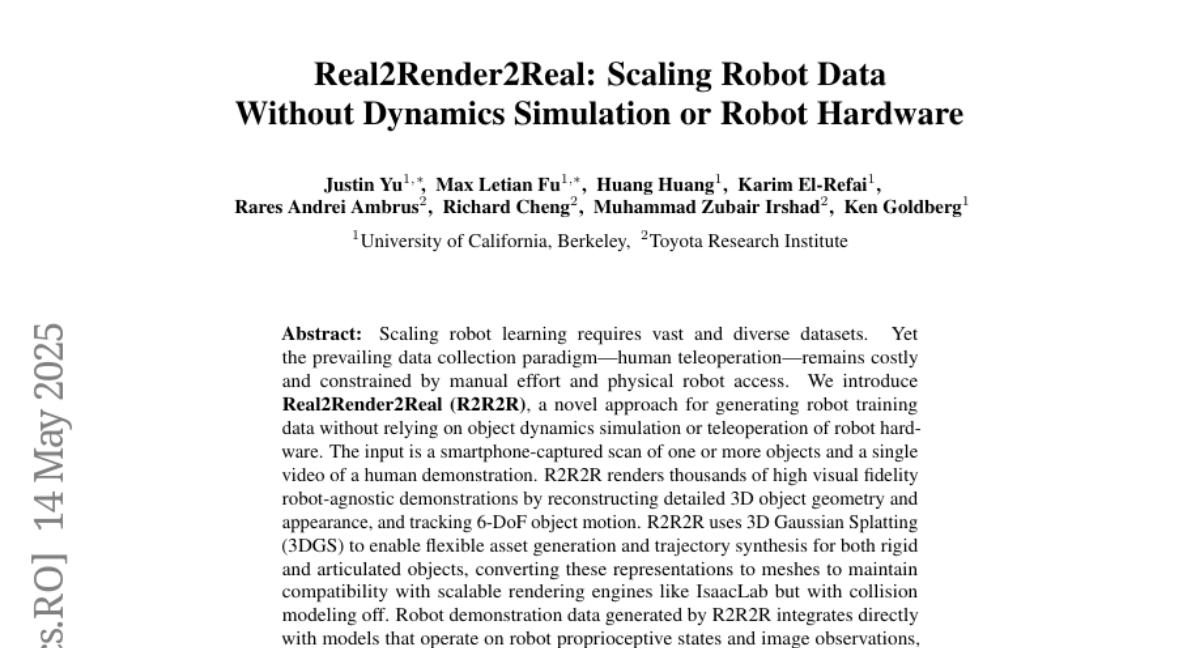
This paper talks about Real2Render2Real (R2R2R), a new way to create training data for robots by using 3D scans and videos instead of relying on expensive simulations or real robot hardware.
What's the problem?
The problem is that teaching robots new skills usually requires either a lot of time with real robots, which can be costly and risky, or using computer simulations that don't always match the real world very well.
What's the solution?
The researchers developed R2R2R, which takes real-world 3D scans and videos and turns them into high-quality, realistic training examples for robots. This lets robots learn from demonstrations that are much closer to what they'd experience in real life, without needing to use actual robots or complicated simulations.
Why it matters?
This matters because it makes robot training faster, cheaper, and more accurate, which helps robots learn new tasks more easily and could speed up progress in areas like manufacturing, healthcare, and everyday robotics.
Abstract
R2R2R generates robot training data from 3D scans and videos, enabling high-fidelity demonstrations for various robot learning tasks.