Reasoning Models Can Be Effective Without Thinking
Wenjie Ma, Jingxuan He, Charlie Snell, Tyler Griggs, Sewon Min, Matei Zaharia
2025-04-15
Summary
This paper talks about how large language models can actually solve problems and reason well even without going through a long, step-by-step thinking process. By using simple instructions, these models can come up with good answers quickly and efficiently.
What's the problem?
The problem is that most AI models are designed to think through problems in a detailed way, which can take a lot of time and computer resources. This makes it hard to use them in situations where you need fast answers or have limited computing power, like on regular laptops or phones.
What's the solution?
The researchers found that if you prompt these models in a straightforward way, skipping the usual long reasoning steps, they can still perform really well on reasoning tasks. In fact, when you run many of these simple prompts at the same time, the results are just as good or even better than those from models that take a lot longer to think things through.
Why it matters?
This work matters because it shows that you don't always need complicated or slow AI to get smart answers. By using simple prompting, more people can access powerful reasoning tools without needing expensive hardware, making AI more practical and available for everyday use.
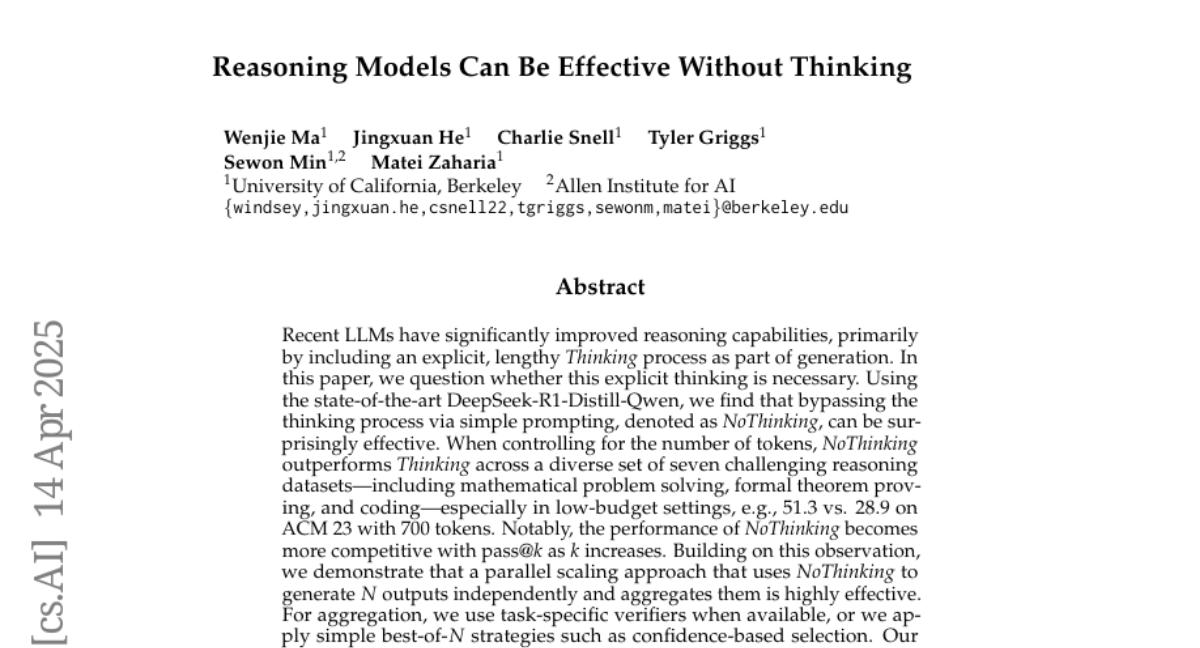
Abstract
Bypassing the explicit thinking process in large language models via simple prompting can lead to effective reasoning performance, especially in low-budget settings, and parallel scaling with this approach matches or surpasses models using lengthy thinking processes.