Reflect-DiT: Inference-Time Scaling for Text-to-Image Diffusion Transformers via In-Context Reflection
Shufan Li, Konstantinos Kallidromitis, Akash Gokul, Arsh Koneru, Yusuke Kato, Kazuki Kozuka, Aditya Grover
2025-03-19
Summary
This paper introduces Reflect-DiT, a way to improve AI image generators by having them learn from their mistakes.
What's the problem?
Making better AI image generators usually means training bigger models with more data, which is expensive.
What's the solution?
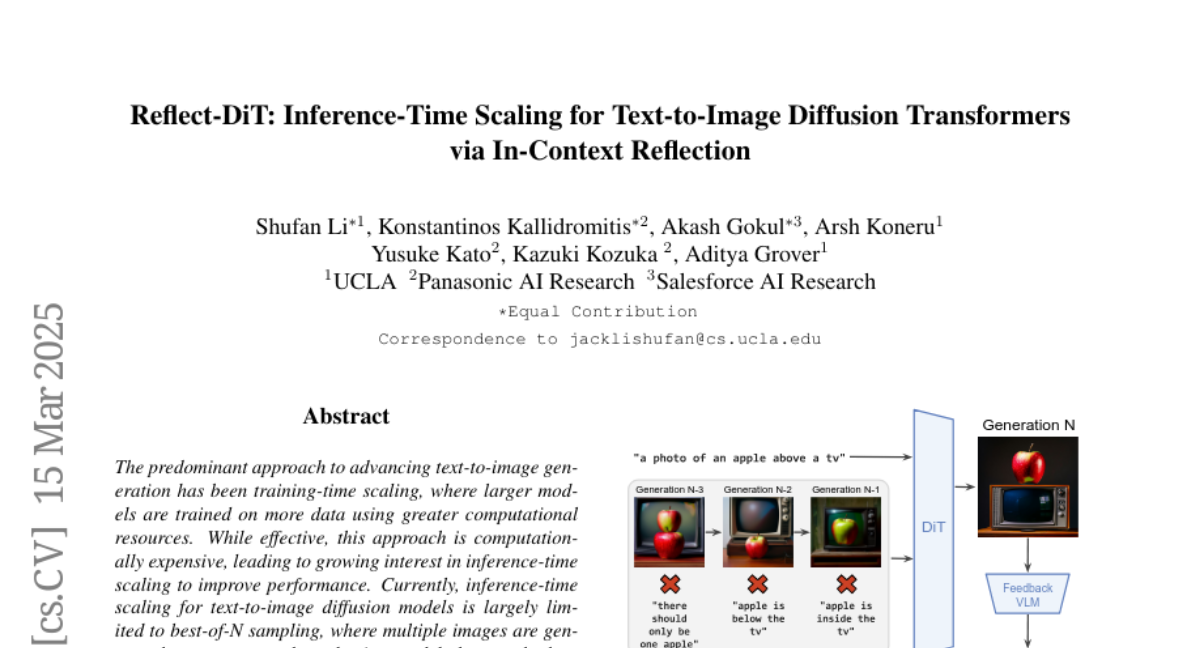
Reflect-DiT lets the AI look at images it created before, get feedback on what's wrong, and then try to fix those problems in the next image it generates.
Why it matters?
This is important because it shows a way to make AI image generators better without needing more training data or a bigger model, saving time and money.
Abstract
The predominant approach to advancing text-to-image generation has been training-time scaling, where larger models are trained on more data using greater computational resources. While effective, this approach is computationally expensive, leading to growing interest in inference-time scaling to improve performance. Currently, inference-time scaling for text-to-image diffusion models is largely limited to best-of-N sampling, where multiple images are generated per prompt and a selection model chooses the best output. Inspired by the recent success of reasoning models like DeepSeek-R1 in the language domain, we introduce an alternative to naive best-of-N sampling by equipping text-to-image Diffusion Transformers with in-context reflection capabilities. We propose Reflect-DiT, a method that enables Diffusion Transformers to refine their generations using in-context examples of previously generated images alongside textual feedback describing necessary improvements. Instead of passively relying on random sampling and hoping for a better result in a future generation, Reflect-DiT explicitly tailors its generations to address specific aspects requiring enhancement. Experimental results demonstrate that Reflect-DiT improves performance on the GenEval benchmark (+0.19) using SANA-1.0-1.6B as a base model. Additionally, it achieves a new state-of-the-art score of 0.81 on GenEval while generating only 20 samples per prompt, surpassing the previous best score of 0.80, which was obtained using a significantly larger model (SANA-1.5-4.8B) with 2048 samples under the best-of-N approach.