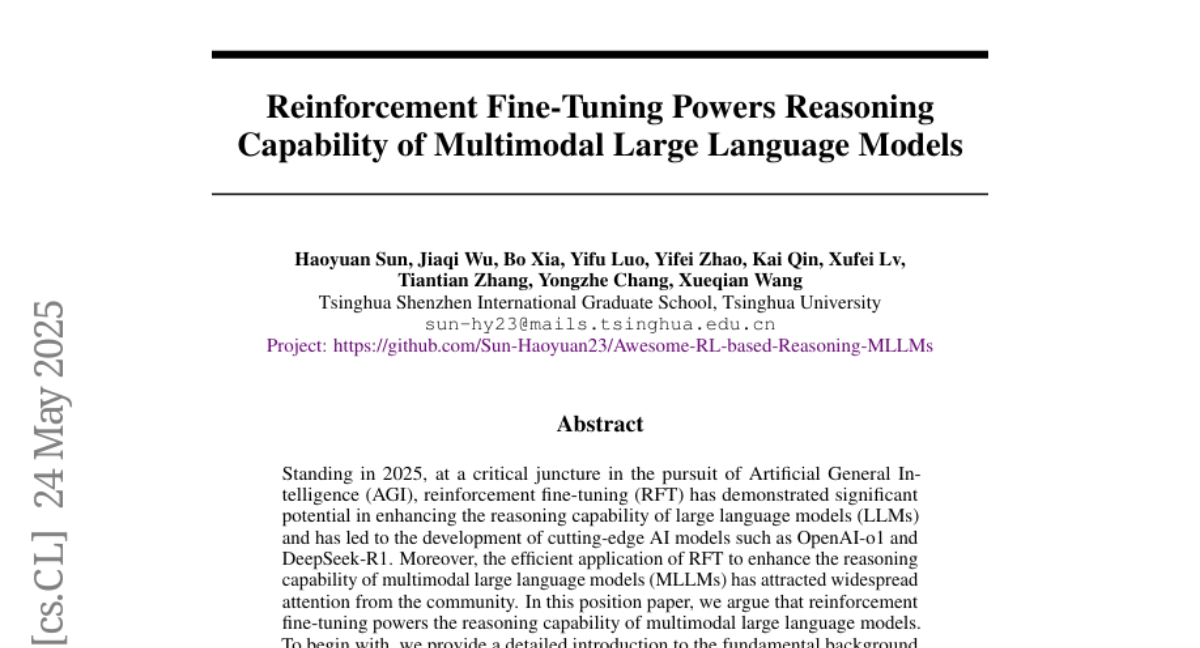
Reinforcement Fine-Tuning Powers Reasoning Capability of Multimodal Large Language Models
Haoyuan Sun, Jiaqi Wu, Bo Xia, Yifu Luo, Yifei Zhao, Kai Qin, Xufei Lv, Tiantian Zhang, Yongzhe Chang, Xueqian Wang
2025-05-27
Summary
This paper talks about how using a special training method called reinforcement fine-tuning can make large language models that handle both text and images much better at reasoning and solving different kinds of problems.
What's the problem?
The problem is that even though these powerful models can understand text and images together, they often aren't very good at thinking things through or making logical connections across different types of information.
What's the solution?
To fix this, the researchers used reinforcement fine-tuning, which is a way of training the models by rewarding them for good answers and guiding them to improve. They tested this approach using a variety of tasks, data types, and evaluation methods to show that it really helps the models become better at reasoning.
Why it matters?
This is important because smarter models that can reason well across both text and images are more useful for real-world applications, like helping with homework, understanding complex information, or assisting in creative projects.
Abstract
Reinforcement fine-tuning significantly enhances the reasoning capabilities of multimodal large language models through diverse modalities, tasks, algorithms, benchmarks, and frameworks.