Reinforcement Learning for Reasoning in Small LLMs: What Works and What Doesn't
Quy-Anh Dang, Chris Ngo
2025-03-21
Summary
This paper explores how to make smaller AI language models better at reasoning using a technique called reinforcement learning.
What's the problem?
Training AI models to reason well usually requires a lot of computing power and data, which is expensive and not accessible to everyone.
What's the solution?
The researchers found a way to use reinforcement learning to improve the reasoning abilities of a small language model, even with limited resources.
Why it matters?
This work matters because it shows that it's possible to create AI models that are good at reasoning without spending a fortune.
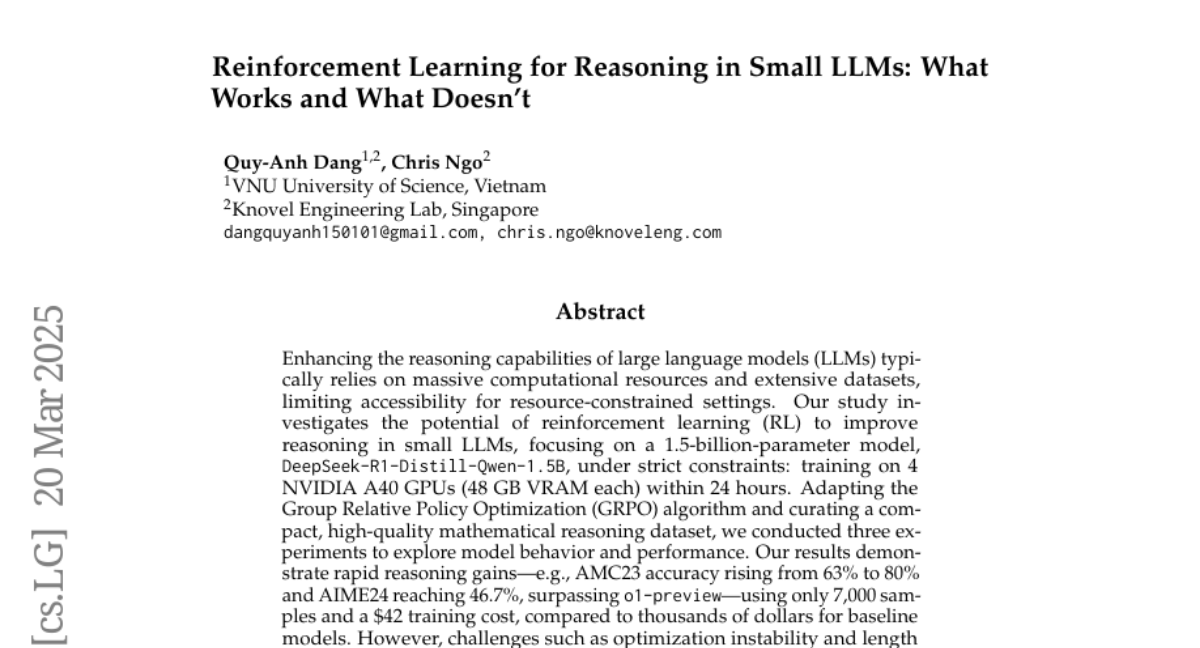
Abstract
Enhancing the reasoning capabilities of large language models (LLMs) typically relies on massive computational resources and extensive datasets, limiting accessibility for resource-constrained settings. Our study investigates the potential of reinforcement learning (RL) to improve reasoning in small LLMs, focusing on a 1.5-billion-parameter model, DeepSeek-R1-Distill-Qwen-1.5B, under strict constraints: training on 4 NVIDIA A40 GPUs (48 GB VRAM each) within 24 hours. Adapting the Group Relative Policy Optimization (GRPO) algorithm and curating a compact, high-quality mathematical reasoning dataset, we conducted three experiments to explore model behavior and performance. Our results demonstrate rapid reasoning gains - e.g., AMC23 accuracy rising from 63% to 80% and AIME24 reaching 46.7%, surpassing o1-preview - using only 7,000 samples and a $42 training cost, compared to thousands of dollars for baseline models. However, challenges such as optimization instability and length constraints emerged with prolonged training. These findings highlight the efficacy of RL-based fine-tuning for small LLMs, offering a cost-effective alternative to large-scale approaches. We release our code and datasets as open-source resources, providing insights into trade-offs and laying a foundation for scalable, reasoning-capable LLMs in resource-limited environments. All are available at https://github.com/knoveleng/open-rs.