Replacing thinking with tool usage enables reasoning in small language models
Corrado Rainone, Tim Bakker, Roland Memisevic
2025-07-17
Summary
This paper talks about a new way to help smaller language models reason better by letting them use tools during their thinking process, rather than trying to figure everything out on their own.
What's the problem?
The problem is that small language models often struggle with complex reasoning tasks because they don't have the size or capacity to process everything internally, which limits their usefulness.
What's the solution?
The authors introduced an approach where the model's actions are recorded as a series of interactions with external tools during training, which helps the model learn more efficiently by getting clearer and faster feedback. This lets smaller models perform tasks like fixing Python code more effectively by relying on tool usage.
Why it matters?
This matters because it shows a way to make smaller, more accessible AI models capable of complex reasoning and problem-solving by combining their strengths with external tools, which can lead to faster and smarter AI applications without needing huge models.
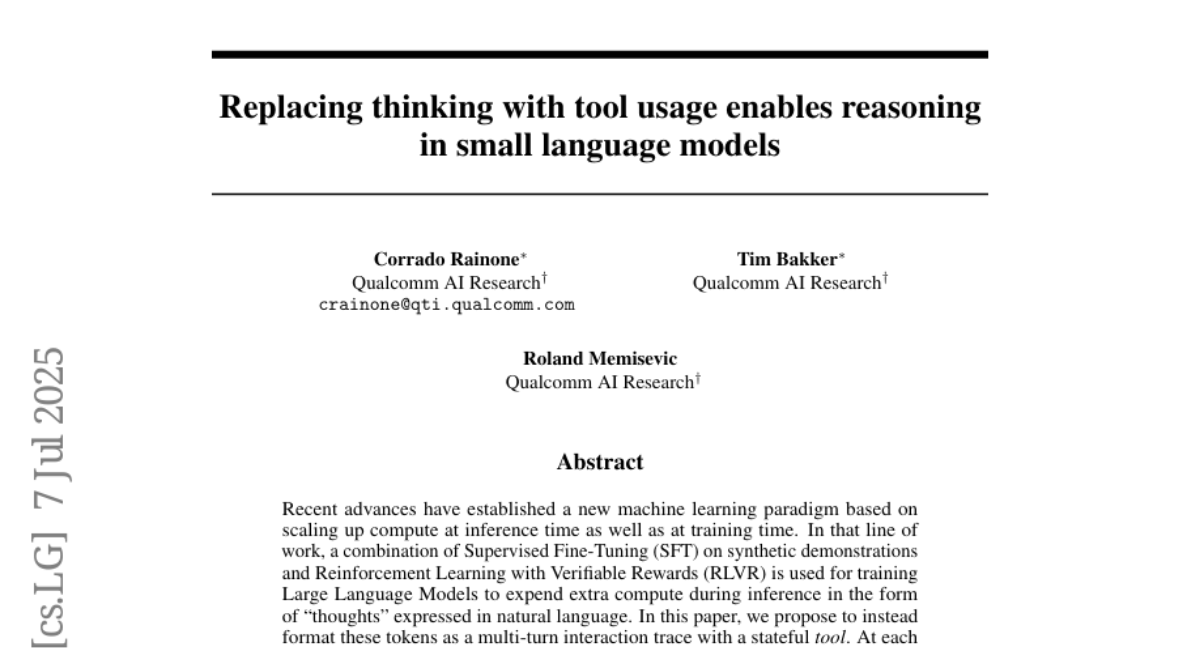
Abstract
A new approach formats tokens as a multi-turn interaction trace with a stateful tool for training Large Language Models, enabling faster sampling and denser reward signals for tasks like repairing Python code.