RepText: Rendering Visual Text via Replicating
Haofan Wang, Yujia Xu, Yimeng Li, Junchen Li, Chaowei Zhang, Jing Wang, Kejia Yang, Zhibo Chen
2025-04-29
Summary
This paper talks about RepText, a new tool that lets AI models create images with accurate text in any language and font, even if the AI doesn't actually understand the language it's drawing.
What's the problem?
The problem is that most text-to-image AI models struggle to make text look right in images, especially when it comes to non-English languages or fancy fonts. They often mess up the shapes of letters or can't handle different alphabets, so the text in their images looks weird or unreadable.
What's the solution?
The researchers built RepText to work with existing AI image generators by focusing on copying the visual shapes of letters (called glyphs) instead of trying to understand what the text means. They use a system called ControlNet to guide where and how the text should appear, and they add special tricks like comparing the generated text to real text shapes and only changing the parts of the image where the text goes. This helps the AI create clear, accurate text in any language or style the user wants.
Why it matters?
This matters because it makes AI much better at creating posters, ads, comics, or any images that need readable and stylish text, no matter the language. It also means people can use these tools for more creative and international projects without running into the usual problems with messed-up text.
Abstract
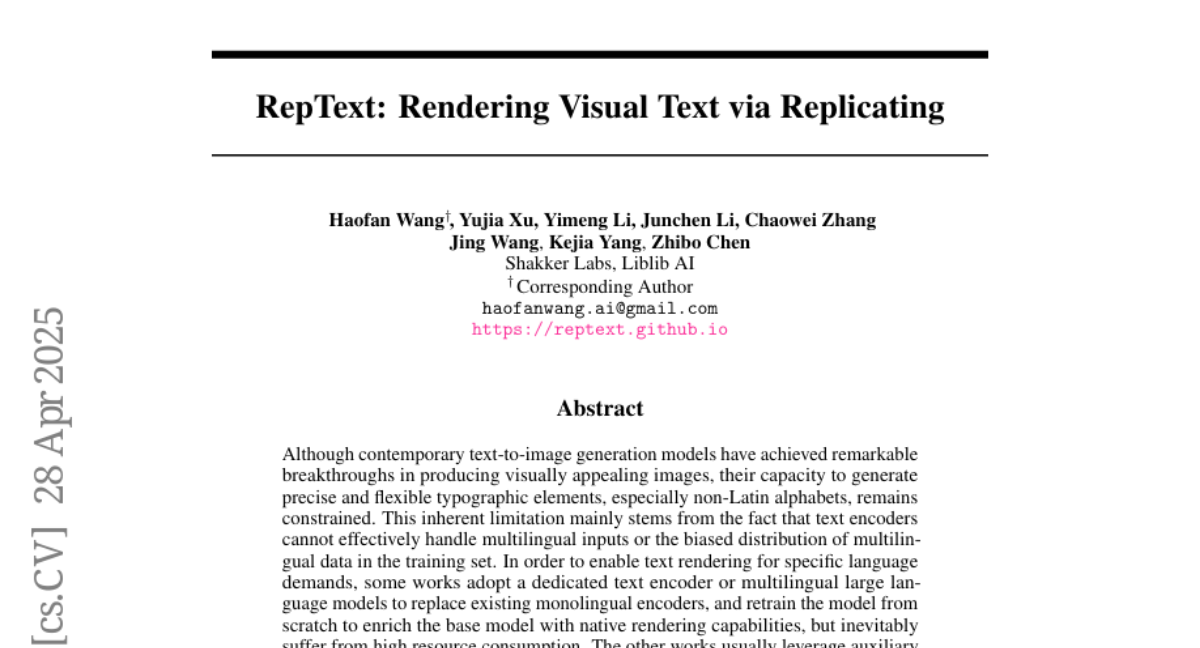
RepText enhances pre-trained monolingual text-to-image models to generate precise multilingual text in specified fonts using ControlNet and a text perceptual loss.