Rethinking RL Scaling for Vision Language Models: A Transparent, From-Scratch Framework and Comprehensive Evaluation Scheme
Yan Ma, Steffi Chern, Xuyang Shen, Yiran Zhong, Pengfei Liu
2025-04-04
Summary
This paper talks about improving how AI models that understand both images and text can learn better decision-making through a simpler, clearer method. It focuses on using reinforcement learning (a type of AI training where models learn by trial and error) to help these models get smarter at tasks like answering questions about pictures.
What's the problem?
Current methods for training these AI models are too complicated and hard to copy, making it tough for researchers to compare results or understand how the models learn. There’s also no standard way to test how well the models perform, which makes it hard to know if new ideas actually work.
What's the solution?
The researchers created a straightforward, four-step training method that anyone can use to apply reinforcement learning to these models. They also made a standard testing plan to check how the models learn over time and how well they think through problems. This approach was tested on different models and tasks, showing that reinforcement learning helps models handle new situations better than older training methods.
Why it matters?
This matters because it makes AI research more open and easier to build on. By having a clear, simple way to train and test these models, more people can improve how AI understands the world through images and words, leading to smarter tools for things like education or accessibility.
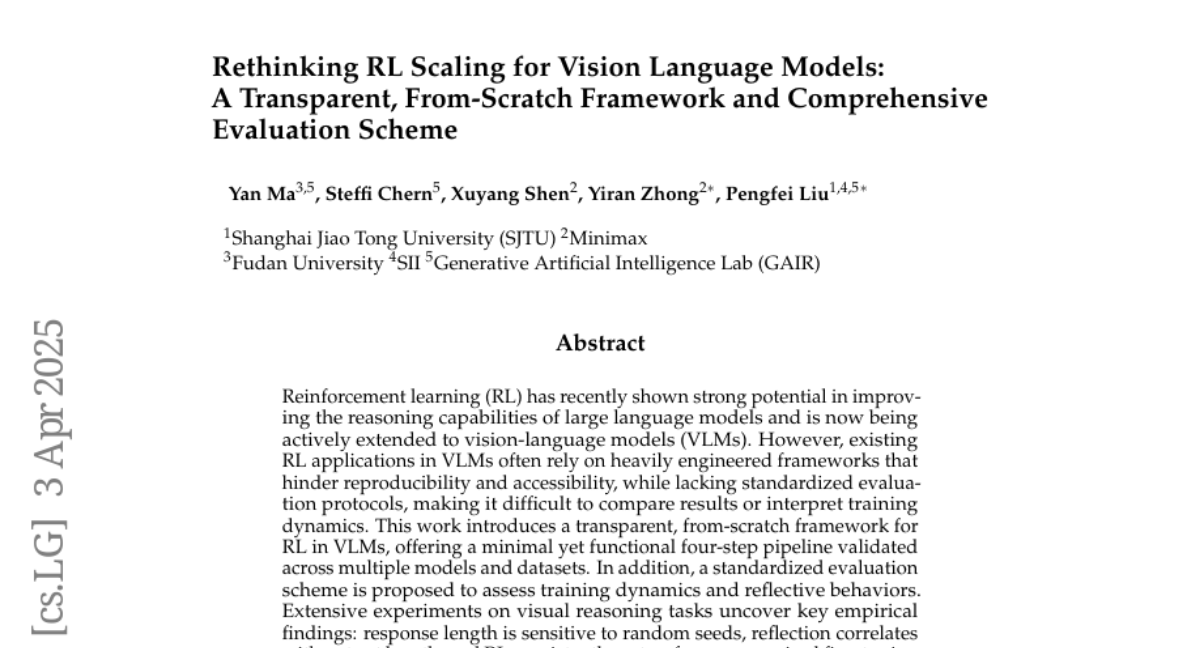
Abstract
Reinforcement learning (RL) has recently shown strong potential in improving the reasoning capabilities of large language models and is now being actively extended to vision-language models (VLMs). However, existing RL applications in VLMs often rely on heavily engineered frameworks that hinder reproducibility and accessibility, while lacking standardized evaluation protocols, making it difficult to compare results or interpret training dynamics. This work introduces a transparent, from-scratch framework for RL in VLMs, offering a minimal yet functional four-step pipeline validated across multiple models and datasets. In addition, a standardized evaluation scheme is proposed to assess training dynamics and reflective behaviors. Extensive experiments on visual reasoning tasks uncover key empirical findings: response length is sensitive to random seeds, reflection correlates with output length, and RL consistently outperforms supervised fine-tuning (SFT) in generalization, even with high-quality data. These findings, together with the proposed framework, aim to establish a reproducible baseline and support broader engagement in RL-based VLM research.