Revisiting Bi-Linear State Transitions in Recurrent Neural Networks
M. Reza Ebrahimi, Roland Memisevic
2025-06-02
Summary
This paper talks about how using bilinear operations in recurrent neural networks (RNNs) can help these AI models keep track of information over time, and how this approach creates a kind of hierarchy where the simplest version is just a regular linear RNN.
What's the problem?
The problem is that RNNs, which are used for tasks like language modeling or time series prediction, sometimes struggle to remember and process information from earlier steps, especially when the relationships between pieces of information are complex.
What's the solution?
The researchers showed that by using bilinear operations—basically a more advanced way of combining information—RNNs can naturally do a better job at tracking states and handling more complicated patterns. They also explained how this method fits into a bigger picture, where linear RNNs are just the most basic case.
Why it matters?
This is important because it helps improve how AI models handle sequences and remember information, which can make them better at things like understanding language, predicting events, or analyzing data that changes over time.
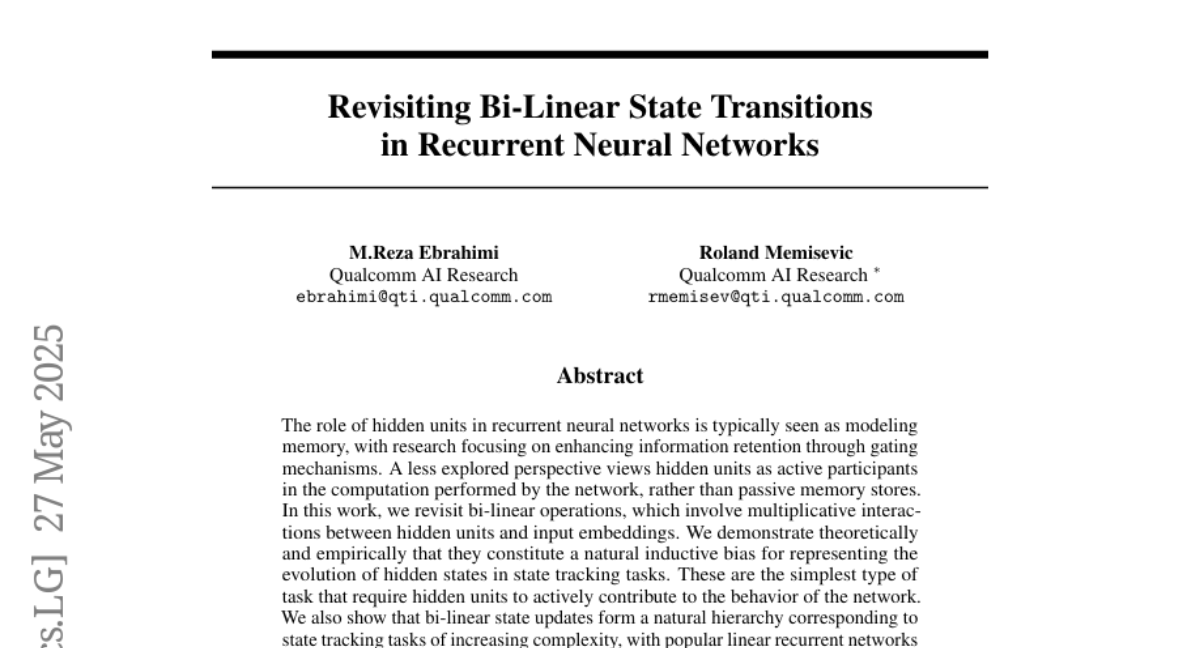
Abstract
Bilinear operations in recurrent neural networks are shown to be a natural bias for state tracking tasks, forming a hierarchical structure where linear recurrent networks are the simplest form.