Revisiting Reinforcement Learning for LLM Reasoning from A Cross-Domain Perspective
Zhoujun Cheng, Shibo Hao, Tianyang Liu, Fan Zhou, Yutao Xie, Feng Yao, Yuexin Bian, Yonghao Zhuang, Nilabjo Dey, Yuheng Zha, Yi Gu, Kun Zhou, Yuqi Wang, Yuan Li, Richard Fan, Jianshu She, Chengqian Gao, Abulhair Saparov, Haonan Li, Taylor W. Killian, Mikhail Yurochkin, Zhengzhong Liu
2025-06-20
Summary
This paper talks about using reinforcement learning to improve the reasoning abilities of large language models across different types of tasks and fields.
What's the problem?
The problem is that large language models often struggle to perform complex reasoning well, especially when applied to new or different areas they were not specifically trained for.
What's the solution?
The researchers created a large collection of diverse reasoning tasks called Guru to help train and test reinforcement learning approaches on large language models. This diverse training improved the models' ability to reason through complicated problems in various domains.
Why it matters?
This matters because better reasoning skills in AI models make them more useful for solving real-world problems, understanding complex information, and helping people in many different fields.
Abstract
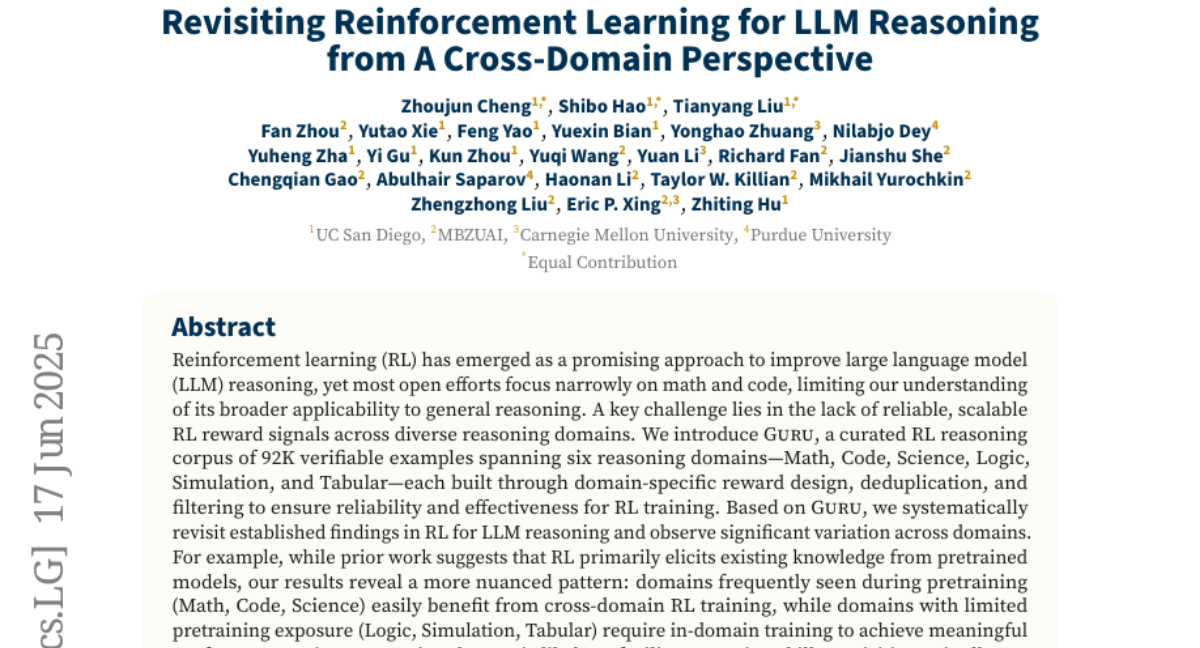
Guru, a diverse RL reasoning corpus, highlights domain-specific training needs and demonstrates improved performance in complex tasks for RL-enhanced LLMs.