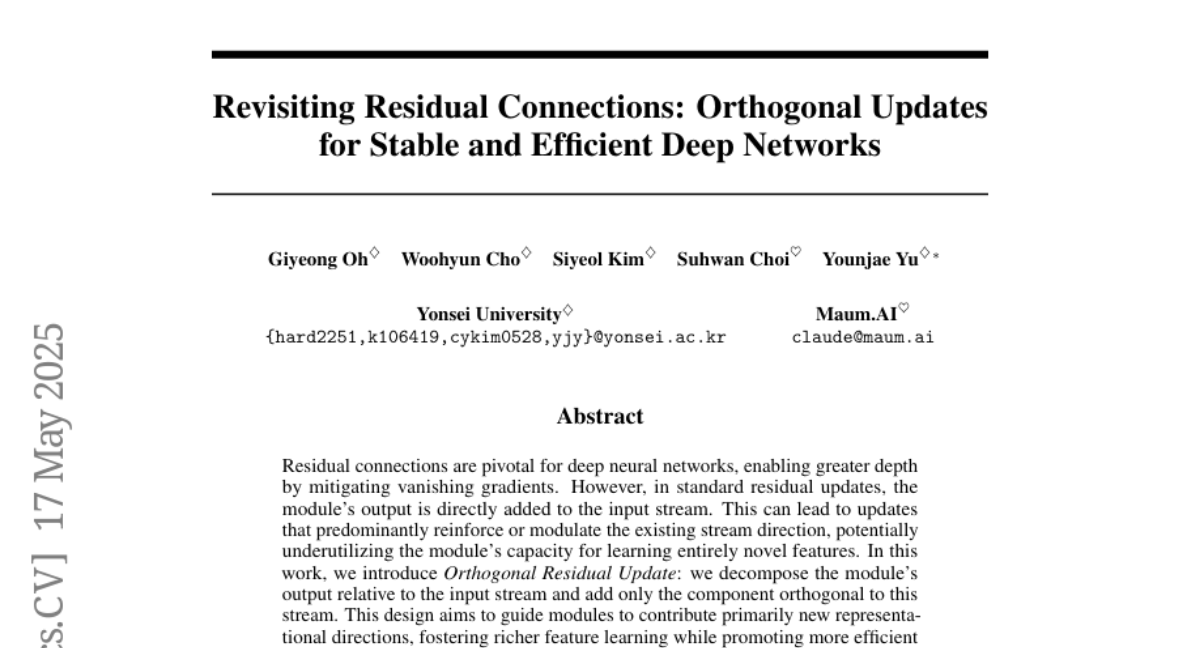
Revisiting Residual Connections: Orthogonal Updates for Stable and Efficient Deep Networks
Giyeong Oh, Woohyun Cho, Siyeol Kim, Suhwan Choi, Younjae Yu
2025-05-26
Summary
This paper talks about a new way to make deep neural networks, which are a type of AI, learn better and be more stable during training by changing how their layers update information.
What's the problem?
The problem is that when training deep networks, the layers can sometimes repeat or mix up information, which can make learning less efficient and even cause the training process to become unstable.
What's the solution?
The researchers introduced orthogonal residual updates, a method that makes each layer in the network focus on adding new, unique information instead of repeating what previous layers have already done. This helps the network learn more useful features and stay stable while training.
Why it matters?
This is important because it means AI models can become smarter and more reliable, which helps in building better systems for things like image recognition, language understanding, and many other tasks.
Abstract
Orthogonal Residual Updates enhance feature learning and training stability by decomposing module outputs to contribute primarily novel features.