Reviving Cultural Heritage: A Novel Approach for Comprehensive Historical Document Restoration
Yuyi Zhang, Peirong Zhang, Zhenhua Yang, Pengyu Yan, Yongxin Shi, Pengwei Liu, Fengjun Guo, Lianwen Jin
2025-07-08
Summary
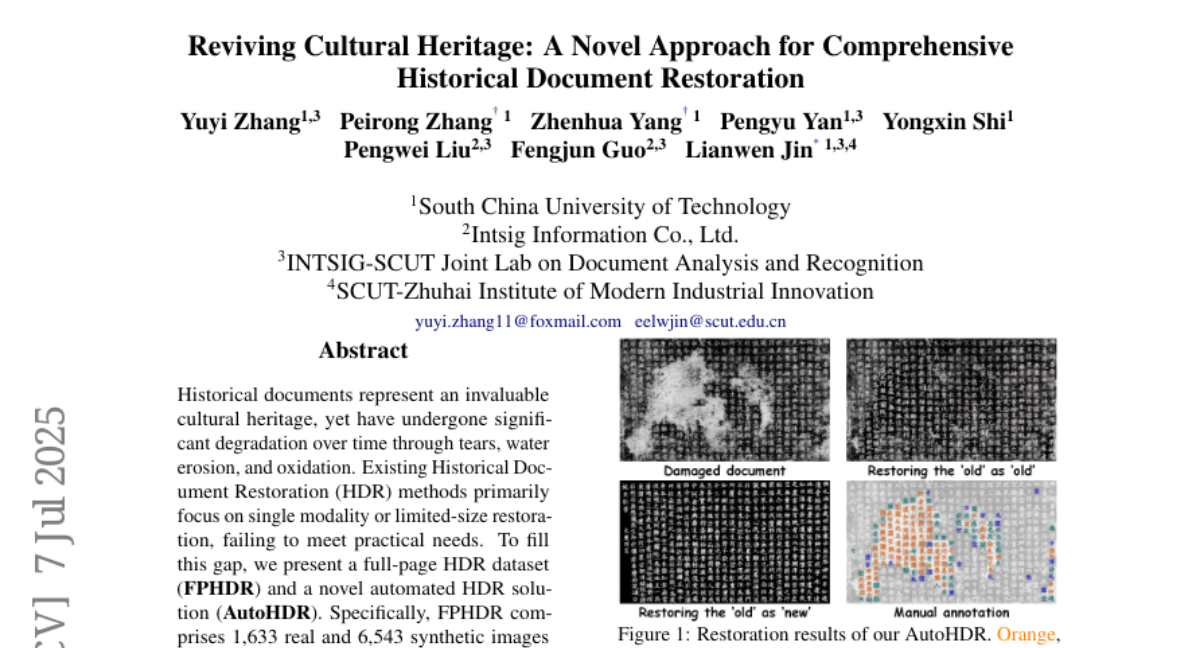
This paper talks about AutoHDR, a new automated system designed to help restore old historical documents. It uses advanced technology to find damaged areas, predict missing parts by understanding context, and then restore the document's appearance step-by-step.
What's the problem?
The problem is that many historical documents are damaged, faded, or torn, making them hard to read and digitize accurately. Traditional restoration methods are slow and require a lot of human effort, and errors in text recognition are common.
What's the solution?
The researchers developed AutoHDR, which works in three stages: first, it uses text recognition to find damaged spots; second, it predicts what the missing or unclear parts might be using vision and language together; third, it restores the image of the document patch by patch using an autoregressive model. This approach improves the quality of restoration and helps both machines and humans work together more effectively.
Why it matters?
This matters because preserving and restoring historical documents is important for maintaining cultural heritage. AutoHDR can make this process faster, more accurate, and less labor-intensive, helping to protect valuable historical records for future generations.
Abstract
AutoHDR, a three-stage automated solution, significantly enhances historical document restoration through OCR-assisted damage localization, vision-language context prediction, and patch autoregressive appearance restoration, improving OCR accuracy and enabling human-machine collaboration.