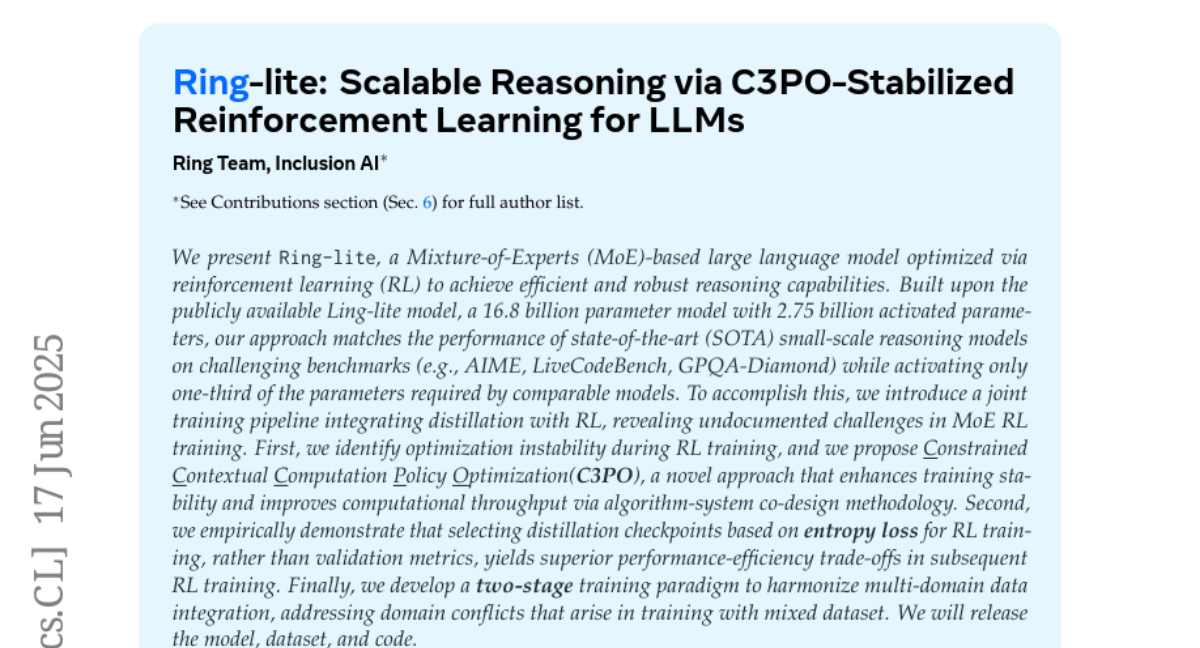
Ring-lite: Scalable Reasoning via C3PO-Stabilized Reinforcement Learning for LLMs
Ring Team, Bin Hu, Cai Chen, Deng Zhao, Ding Liu, Dingnan Jin, Feng Zhu, Hao Dai, Hongzhi Luan, Jia Guo, Jiaming Liu, Jiewei Wu, Jun Mei, Jun Zhou, Junbo Zhao, Junwu Xiong, Kaihong Zhang, Kuan Xu, Lei Liang, Liang Jiang, Liangcheng Fu, Longfei Zheng
2025-06-18
Summary
This paper talks about Ring-lite, a new way to make large language models better at reasoning by using a special type of learning called reinforcement learning with a mix of experts (MoE) architecture, which activates only some parts of the model instead of the whole thing.
What's the problem?
The problem is that many powerful reasoning models use a lot of computing resources because they have to activate many parts of their networks, making them slow and expensive to run. Also, training these mixture of experts models is tricky and can be unstable.
What's the solution?
The researchers developed Ring-lite, which efficiently uses reinforcement learning to train a model that can activate fewer experts and still match the best reasoning models. They also addressed specific problems in training MoE models to make the process more stable and efficient.
Why it matters?
This matters because Ring-lite lets AI reason effectively while using less computing power, which means it can be faster and cheaper to use in real applications without losing performance.
Abstract
Ring-lite uses a MoE architecture and reinforcement learning to efficiently match SOTA reasoning models while activating fewer parameters and addressing challenges specific to MoE training.