RoboBrain 2.0 Technical Report
BAAI RoboBrain Team, Mingyu Cao, Huajie Tan, Yuheng Ji, Minglan Lin, Zhiyu Li, Zhou Cao, Pengwei Wang, Enshen Zhou, Yi Han, Yingbo Tang, Xiangqi Xu, Wei Guo, Yaoxu Lyu, Yijie Xu, Jiayu Shi, Cheng Chi, Mengdi Zhao, Xiaoshuai Hao, Shanyu Rong, Zhengliang Cai, Bolun Zhang
2025-07-08
Summary
This paper talks about RoboBrain 2.0, a vision-language AI model that is really good at tasks where it needs to understand space and time, like figuring out where things are and planning what to do next. It works well on tests that measure these spatial and temporal reasoning skills.
What's the problem?
The problem is that many AI models find it difficult to understand and reason about how objects move and relate to each other over time and space, which is important for tasks like navigation and decision-making.
What's the solution?
The researchers improved RoboBrain by combining vision and language data in a way that helps the system better understand spatial relationships and temporal sequences. This helps the model make smarter decisions by considering both where things are and how they change over time.
Why it matters?
This matters because it makes AI more capable of handling real-world tasks that require understanding of both the physical environment and timing, which is crucial for robots, autonomous vehicles, and other intelligent systems.
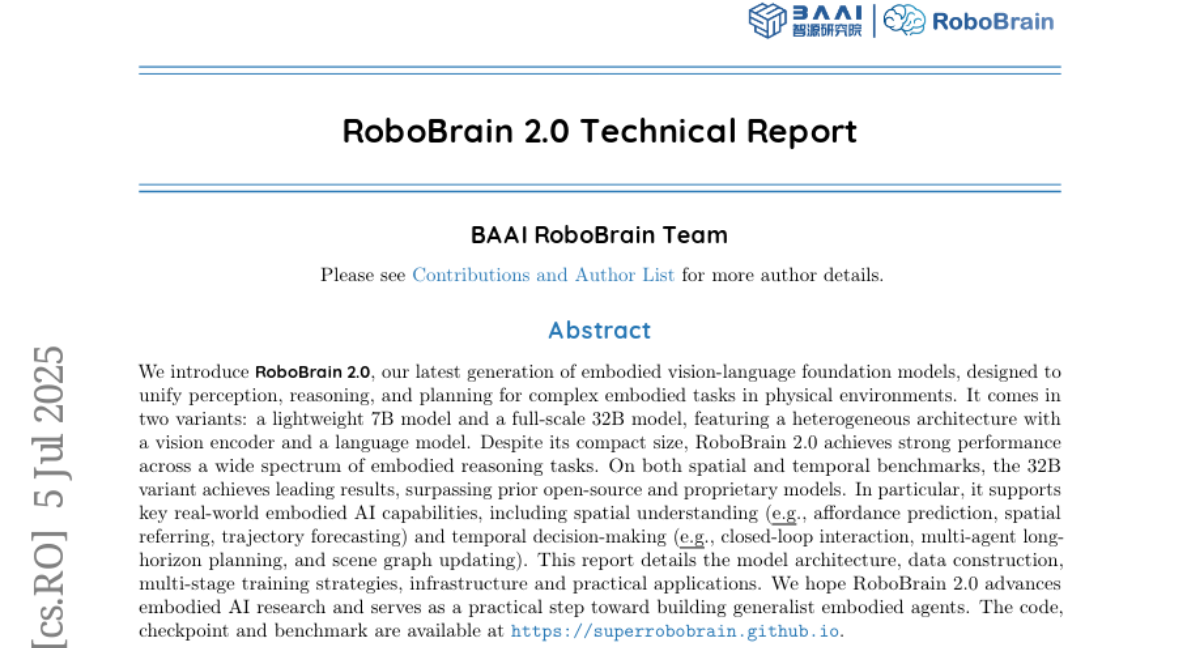
Abstract
RoboBrain 2.0, a heterogeneous vision-language model, excels in embodied reasoning tasks with strong performance on spatial and temporal benchmarks, supporting capabilities like spatial understanding and temporal decision-making.