RoboTwin 2.0: A Scalable Data Generator and Benchmark with Strong Domain Randomization for Robust Bimanual Robotic Manipulation
Tianxing Chen, Zanxin Chen, Baijun Chen, Zijian Cai, Yibin Liu, Qiwei Liang, Zixuan Li, Xianliang Lin, Yiheng Ge, Zhenyu Gu, Weiliang Deng, Yubin Guo, Tian Nian, Xuanbing Xie, Qiangyu Chen, Kailun Su, Tianling Xu, Guodong Liu, Mengkang Hu, Huan-ang Gao, Kaixuan Wang, Zhixuan Liang
2025-06-26
Summary
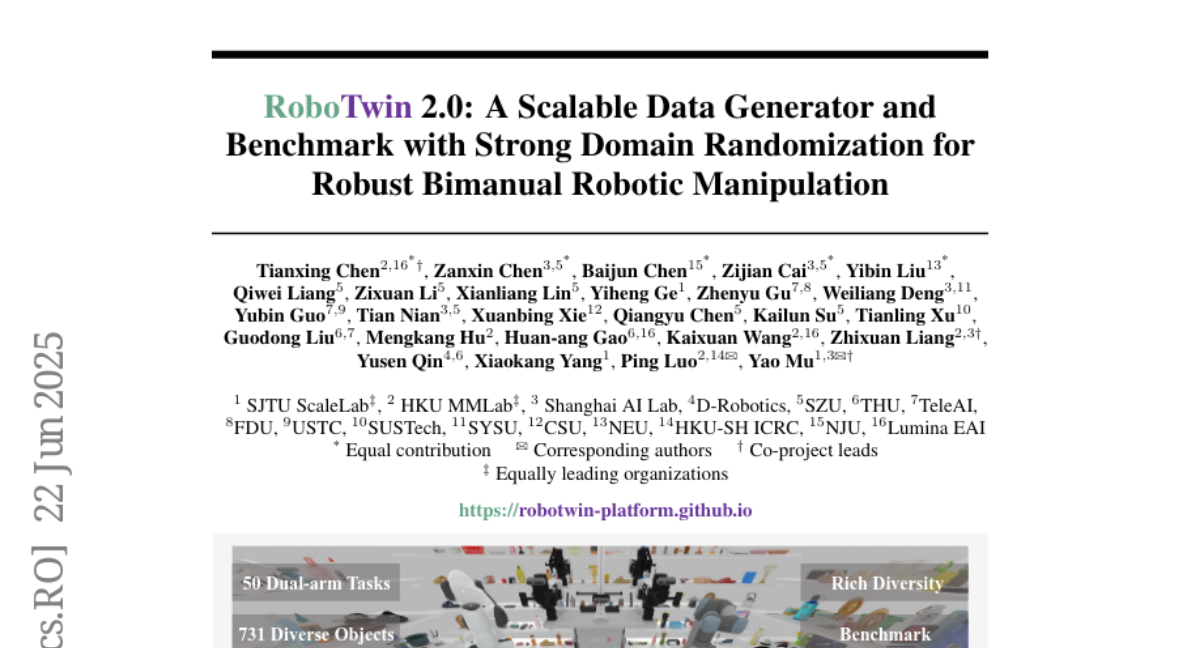
This paper talks about RoboTwin 2.0, a simulation system designed to create training data for robots that use two arms to manipulate objects. It generates lots of varied and realistic synthetic data to help robots learn better.
What's the problem?
The problem is that training robots to use two arms effectively in the real world is hard because collecting enough real training data is difficult and robots often fail when moving from simulated training to real environments due to differences between them.
What's the solution?
The researchers improved the simulation by using expert knowledge to create synthetic data and applied structured domain randomization, which means they varied many aspects of the environment during training to make the data more diverse and realistic. This helps robots trained in simulation perform better in the real world.
Why it matters?
This matters because it speeds up and improves the training of robotic systems with two arms, making them more reliable and versatile for tasks like assembling objects, helping in factories, or even in homes.
Abstract
RoboTwin 2.0 is a scalable simulation framework for bimanual robotic manipulation that uses expert data synthesis and structured domain randomization to generate diverse and realistic synthetic data, improving sim-to-real transfer and generalization.