SAEs Can Improve Unlearning: Dynamic Sparse Autoencoder Guardrails for Precision Unlearning in LLMs
Aashiq Muhamed, Jacopo Bonato, Mona Diab, Virginia Smith
2025-04-14
Summary
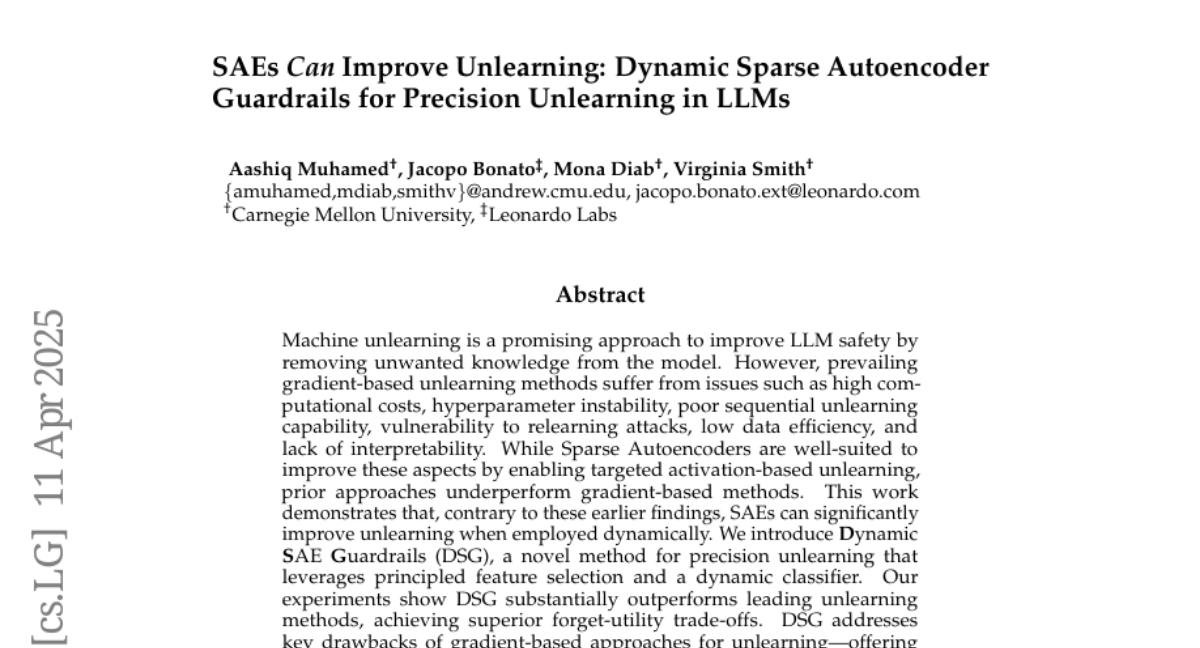
This paper talks about a new way to help large language models, like the ones used in chatbots, forget specific information more precisely and safely. The method uses something called Dynamic Sparse Autoencoder (DAE) Guardrails, which act like smart filters to control what the model remembers or forgets.
What's the problem?
The problem is that when we want an AI to 'unlearn' or forget certain information, the usual methods aren't always reliable. Traditional techniques, which use something called gradients, can be slow, unstable, and might not fully erase what needs to be forgotten. This is a big issue if the AI accidentally learned private or incorrect information and we need to remove it quickly and completely.
What's the solution?
The researchers created Dynamic DAE Guardrails, which use a special kind of neural network that can focus only on the parts of the model related to what needs to be forgotten. This approach is more efficient and stable than older methods, and it makes it easier to see and control exactly what the AI is unlearning.
Why it matters?
This work matters because it helps make AI models safer and more trustworthy. With better ways to make AIs forget sensitive or wrong information, we can protect people's privacy and make sure the technology is used responsibly.
Abstract
Dynamic DAE Guardrails improve machine unlearning in large language models by overcoming limitations of gradient-based methods and offering enhanced efficiency, stability, and interpretability.