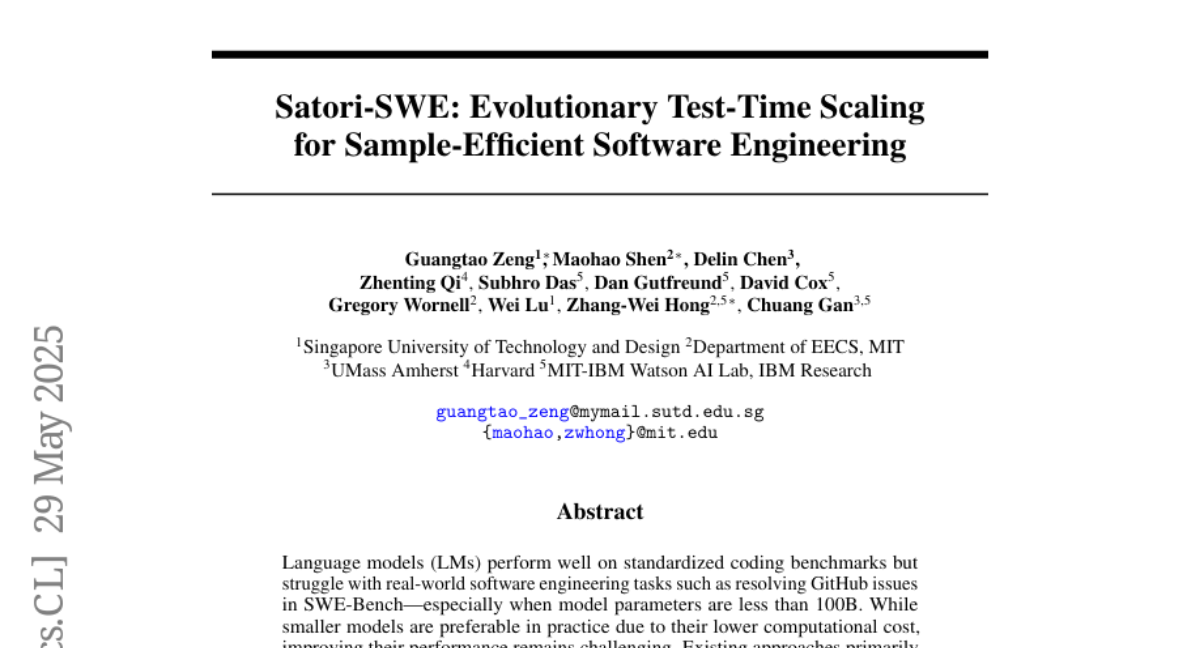
Satori-SWE: Evolutionary Test-Time Scaling for Sample-Efficient Software Engineering
Guangtao Zeng, Maohao Shen, Delin Chen, Zhenting Qi, Subhro Das, Dan Gutfreund, David Cox, Gregory Wornell, Wei Lu, Zhang-Wei Hong, Chuang Gan
2025-05-30
Summary
This paper talks about Satori-SWE, a new way to help smaller AI models get much better at solving real software engineering problems by using methods inspired by evolution and reinforcement learning.
What's the problem?
The problem is that most small language models struggle to perform well on complex programming tasks, and it's hard to make them as effective as bigger, more expensive models without a lot of extra training or resources.
What's the solution?
The researchers created EvoScale, a system that lets the AI improve its answers over time by trying different solutions, learning from its mistakes, and gradually getting better, similar to how evolution works in nature. This helps the smaller models become much more efficient and accurate at coding tasks.
Why it matters?
This is important because it means even less powerful AI systems can be made useful for real-world software engineering, making advanced coding help more accessible and affordable for everyone, not just big companies with lots of resources.
Abstract
EvoScale, an evolutionary and reinforcement learning-based method, enhances small language models' performance on real-world software engineering tasks by iteratively improving and refining outputs.