Scalable Chain of Thoughts via Elastic Reasoning
Yuhui Xu, Hanze Dong, Lei Wang, Doyen Sahoo, Junnan Li, Caiming Xiong
2025-05-09
Summary
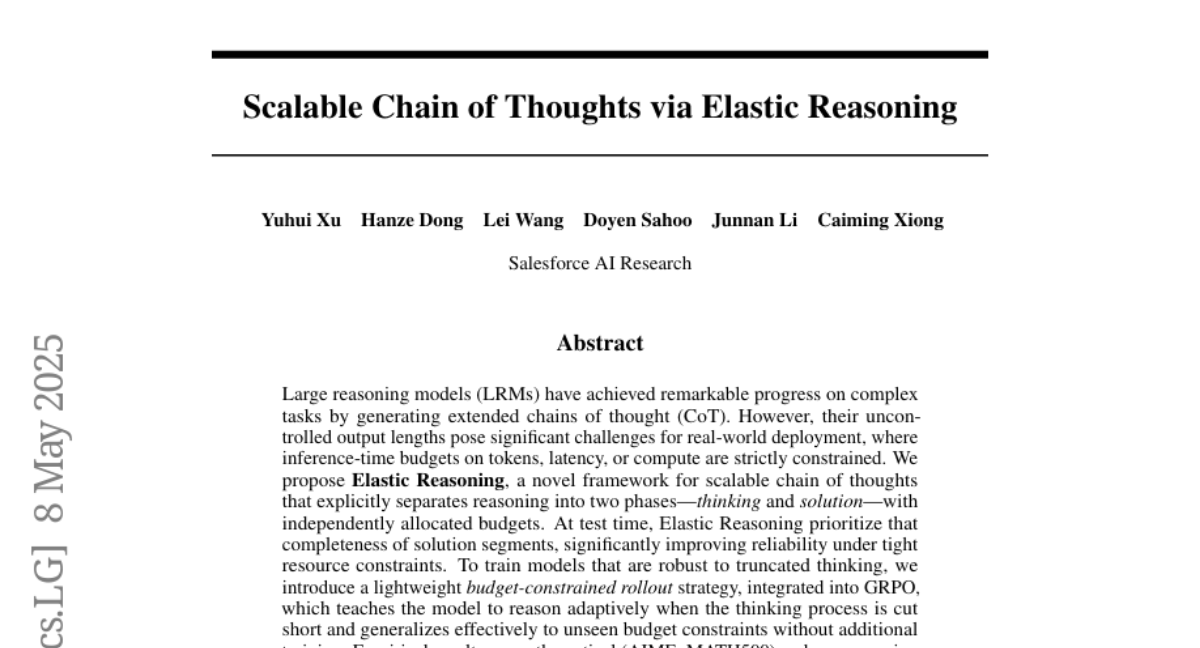
This paper talks about Elastic Reasoning, a new approach that helps AI models solve problems more effectively by splitting their reasoning process into two parts: one for thinking things through and one for actually coming up with the answer.
What's the problem?
The problem is that when AI models try to solve complicated problems, they often use up a lot of computer resources, and it's hard to control how much time or power they spend on each step. This can make them slow or unreliable, especially when resources are limited.
What's the solution?
The researchers designed Elastic Reasoning to give separate 'budgets' or limits for the thinking phase and the solution phase. This means the AI can manage its resources better, spending just the right amount of effort on each part, which leads to more reliable and efficient problem solving.
Why it matters?
This matters because it helps AI models work faster and more consistently, even when they're running on devices or systems with limited resources. Better resource management makes AI more practical and useful in real-world situations, from smartphones to big research projects.
Abstract
Elastic Reasoning is a framework that divides reasoning into thinking and solution phases with separate budgets, improving model reliability and efficiency under resource constraints.