Scaling Laws for Optimal Data Mixtures
Mustafa Shukor, Louis Bethune, Dan Busbridge, David Grangier, Enrico Fini, Alaaeldin El-Nouby, Pierre Ablin
2025-07-16
Summary
This paper talks about scaling laws that help predict the best way to mix different types of training data for large AI models, like language or vision models, to improve their performance and reduce wasted effort.
What's the problem?
The problem is that training large AI models requires data from many different sources or domains, and figuring out how much of each type to use usually involves a lot of trial and error, which is slow and expensive.
What's the solution?
The authors came up with a mathematical method that uses scaling laws to predict how well a model will do based on its size, the amount of data, and the proportions of different data types used for training. By running just a few small experiments, they can accurately estimate the best mix for much bigger models, making training more efficient and predictable.
Why it matters?
This matters because it helps AI researchers and engineers save time, money, and computational resources by avoiding guesswork in data preparation. It also leads to better-performing models by using the right combination of training data from the start.
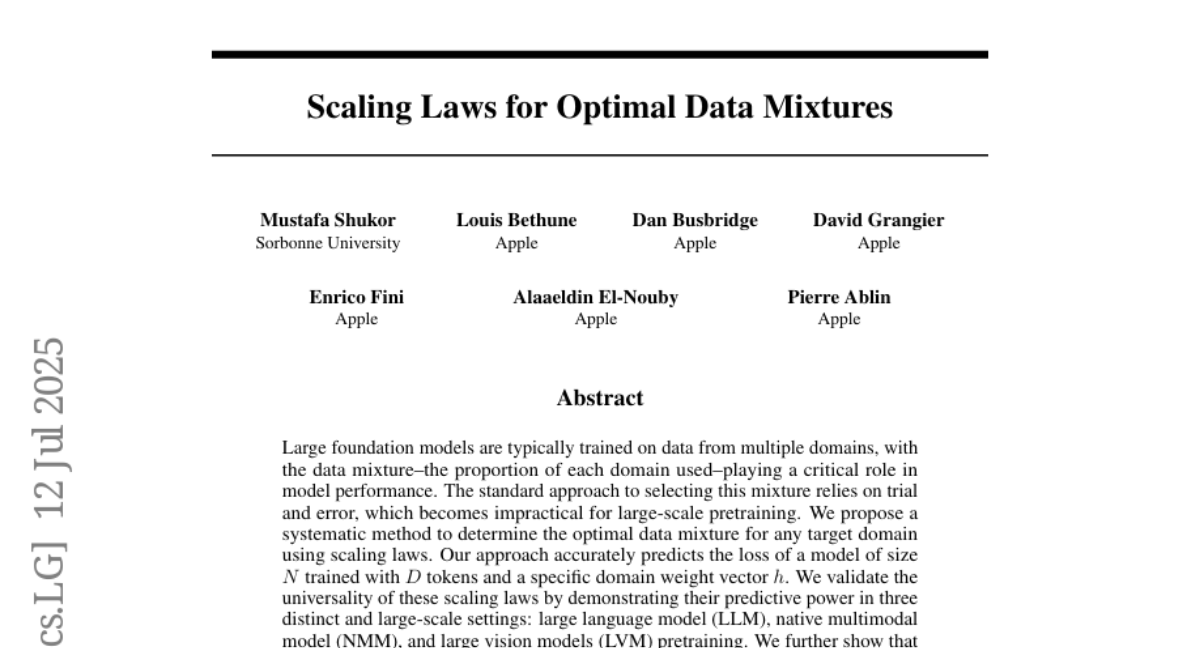
Abstract
Scaling laws predict optimal data mixtures for large foundation models across different domains, improving performance and reducing trial-and-error.