Scaling Speculative Decoding with Lookahead Reasoning
Yichao Fu, Rui Ge, Zelei Shao, Zhijie Deng, Hao Zhang
2025-06-25
Summary
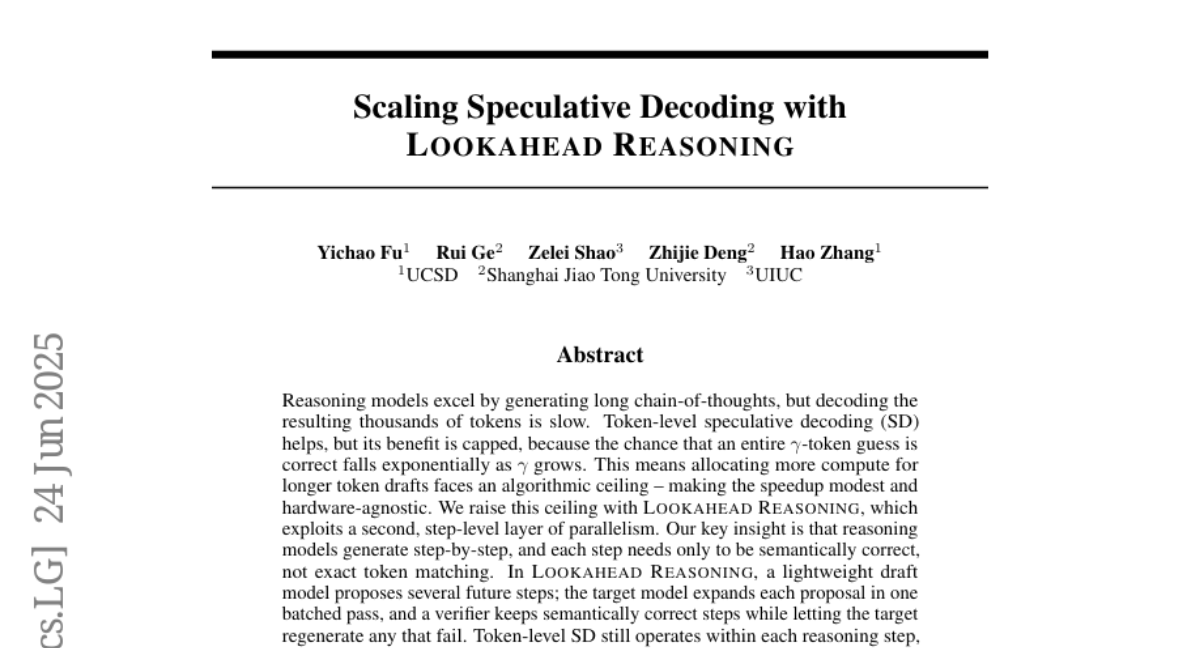
This paper talks about Lookahead Reasoning, a new method that speeds up AI models when they solve problems step-by-step by predicting multiple future steps at once and checking if they make sense.
What's the problem?
The problem is that AI models that reason through long chains of thought are slow because they generate one token at a time, and existing methods to speed up this process have limits because guessing longer sequences gets harder and less accurate.
What's the solution?
The researchers made a system where a smaller, faster model proposes several future reasoning steps together, then the main model verifies these steps in parallel, accepting the ones that are logically correct and redoing the ones that aren't. This two-layer process combines step-level and token-level predictions to speed up reasoning without losing quality.
Why it matters?
This matters because it helps AI solve complex problems faster while keeping answers accurate, improving AI applications like math problem-solving, decision-making, and other tasks that need long and careful reasoning.
Abstract
Lookahead Reasoning enhances the speed of speculative decoding by introducing step-level parallelism, improving speedup over token-level decoding while maintaining answer quality.