SeqPE: Transformer with Sequential Position Encoding
Huyang Li, Yahui Liu, Hongyu Sun, Deng Cai, Leyang Cui, Wei Bi, Peilin Zhao, Taro Watanabe
2025-06-17
Summary
This paper talks about SeqPE, which is a new way of letting Transformer models learn and use positional information more flexibly. Traditional Transformers need to know the position of words or parts in a sequence to understand order, and SeqPE improves how this position information is learned and used. It makes the model better at adapting to different tasks and sequence types, including handling multiple dimensions of data smoothly.
What's the problem?
The problem is that regular position encoding methods in Transformers are often fixed or limited in how they handle the position of tokens in sequences. They might not work well when sequences get very long or when the data has complex, multi-dimensional structures. This limits the model's ability to understand and process sequences effectively in various tasks and settings.
What's the solution?
The solution is SeqPE, a fully learnable position encoding system. Instead of using fixed formulas or patterns, SeqPE lets the Transformer learn the best way to represent positions by itself, from the training data. This flexibility allows the model to adjust for different sequence lengths and types, and it can generalize to multidimensional data easily, which improves performance on many tasks.
Why it matters?
This matters because better position encoding means Transformer models can understand order and structure in data more effectively, especially for challenging tasks that involve long sequences or multi-dimensional inputs. SeqPE helps make these models more adaptable and scalable, leading to stronger results and wider usability in areas like language processing, image analysis, and more complex AI applications.
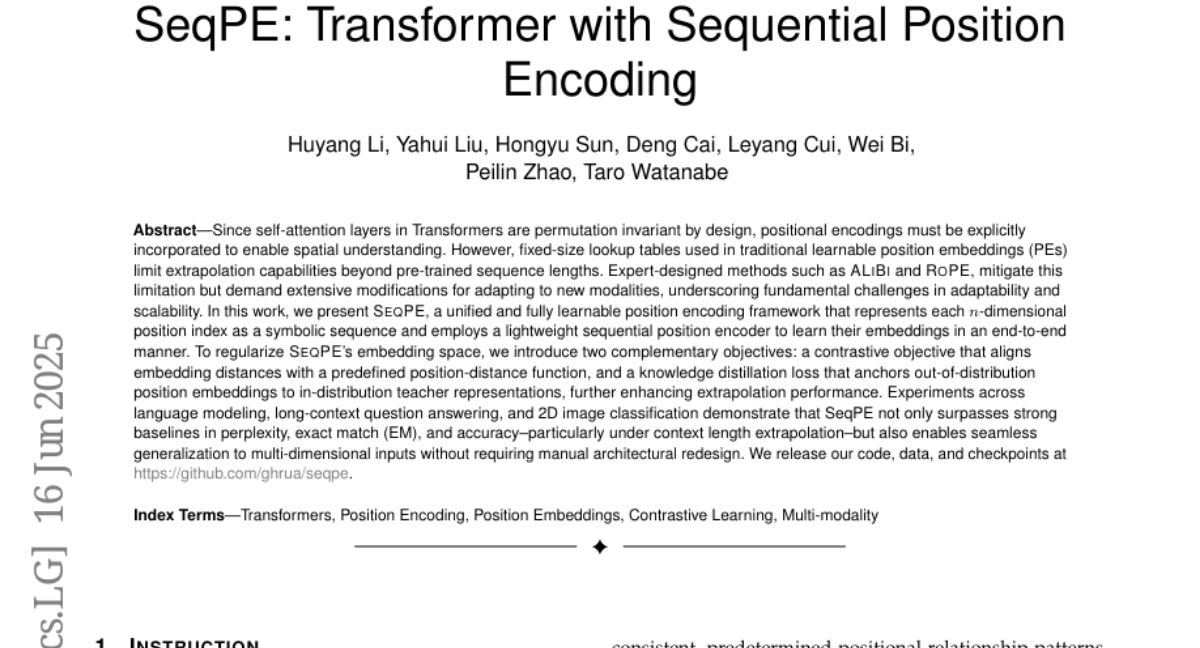
Abstract
SeqPE, a fully learnable position encoding framework, enhances the adaptability and scalability of positional encodings in Transformers, improving performance in various tasks and seamless multi-dimensional generalization.