"Silent Is Not Actually Silent": An Investigation of Toxicity on Bug Report Discussion
Mia Mohammad Imran, Jaydeb Sarker
2025-03-14
Summary
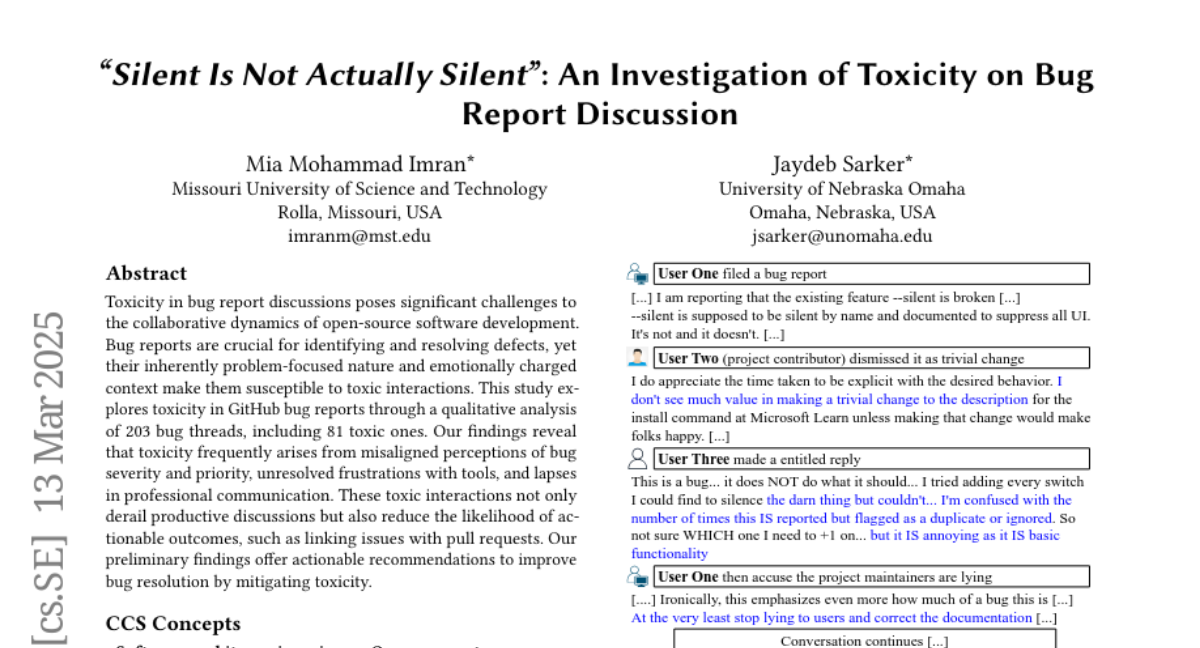
This paper explores toxicity in discussions on GitHub bug reports, which are essential for fixing software problems.
What's the problem?
Bug reports, while important, can become toxic due to disagreements about the severity of bugs, frustration with tools, and unprofessional communication. This toxicity can disrupt discussions and reduce the chances of actually fixing the bugs.
What's the solution?
The researchers analyzed 203 bug report discussions, identifying common sources of toxicity. Their findings offer recommendations to improve bug resolution by reducing toxic interactions.
Why it matters?
This work matters because it addresses a real-world problem in software development, where toxicity can hinder collaboration and slow down the bug-fixing process. By understanding the causes of toxicity, developers can create more productive and positive communication environments.
Abstract
Toxicity in bug report discussions poses significant challenges to the collaborative dynamics of open-source software development. Bug reports are crucial for identifying and resolving defects, yet their inherently problem-focused nature and emotionally charged context make them susceptible to toxic interactions. This study explores toxicity in GitHub bug reports through a qualitative analysis of 203 bug threads, including 81 toxic ones. Our findings reveal that toxicity frequently arises from misaligned perceptions of bug severity and priority, unresolved frustrations with tools, and lapses in professional communication. These toxic interactions not only derail productive discussions but also reduce the likelihood of actionable outcomes, such as linking issues with pull requests. Our preliminary findings offer actionable recommendations to improve bug resolution by mitigating toxicity.