Slow-Fast Architecture for Video Multi-Modal Large Language Models
Min Shi, Shihao Wang, Chieh-Yun Chen, Jitesh Jain, Kai Wang, Junjun Xiong, Guilin Liu, Zhiding Yu, Humphrey Shi
2025-04-07
Summary
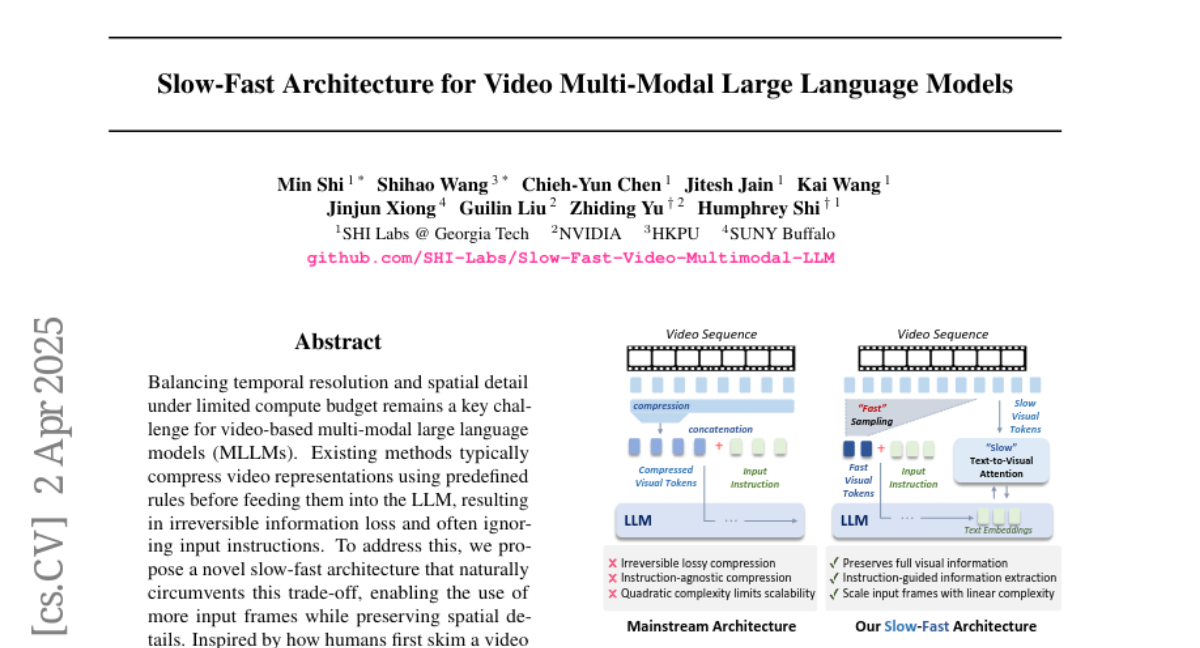
This paper talks about a smart AI system that processes videos like humans do - first skimming for quick context, then focusing on details - to understand videos better without using too much computer power.
What's the problem?
Current video AI tools either lose important details when squishing videos to save energy, or use too much power trying to keep all details, making them slow and inefficient.
What's the solution?
The system uses two pathways: a 'fast' path that quickly summarizes the video, and a 'slow' path that keeps full details which the AI checks only when needed, like how we glance at a scene before examining interesting parts.
Why it matters?
This helps create better video AI assistants that can analyze security footage, explain sports plays, or help filmmakers without needing supercomputers, making video understanding cheaper and more accessible.
Abstract
Balancing temporal resolution and spatial detail under limited compute budget remains a key challenge for video-based multi-modal large language models (MLLMs). Existing methods typically compress video representations using predefined rules before feeding them into the LLM, resulting in irreversible information loss and often ignoring input instructions. To address this, we propose a novel slow-fast architecture that naturally circumvents this trade-off, enabling the use of more input frames while preserving spatial details. Inspired by how humans first skim a video before focusing on relevant parts, our slow-fast design employs a dual-token strategy: 1) "fast" visual tokens -- a compact set of compressed video features -- are fed into the LLM alongside text embeddings to provide a quick overview; 2) "slow" visual tokens -- uncompressed video features -- are cross-attended by text embeddings through specially designed hybrid decoder layers, enabling instruction-aware extraction of relevant visual details with linear complexity. We conduct systematic exploration to optimize both the overall architecture and key components. Experiments show that our model significantly outperforms self-attention-only baselines, extending the input capacity from 16 to 128 frames with just a 3% increase in computation, and achieving a 16% average performance improvement across five video understanding benchmarks. Our 7B model achieves state-of-the-art performance among models of similar size. Furthermore, our slow-fast architecture is a plug-and-play design that can be integrated into other video MLLMs to improve efficiency and scalability.