ST-VLM: Kinematic Instruction Tuning for Spatio-Temporal Reasoning in Vision-Language Models
Dohwan Ko, Sihyeon Kim, Yumin Suh, Vijay Kumar B. G, Minseo Yoon, Manmohan Chandraker, Hyunwoo J. Kim
2025-03-26
Summary
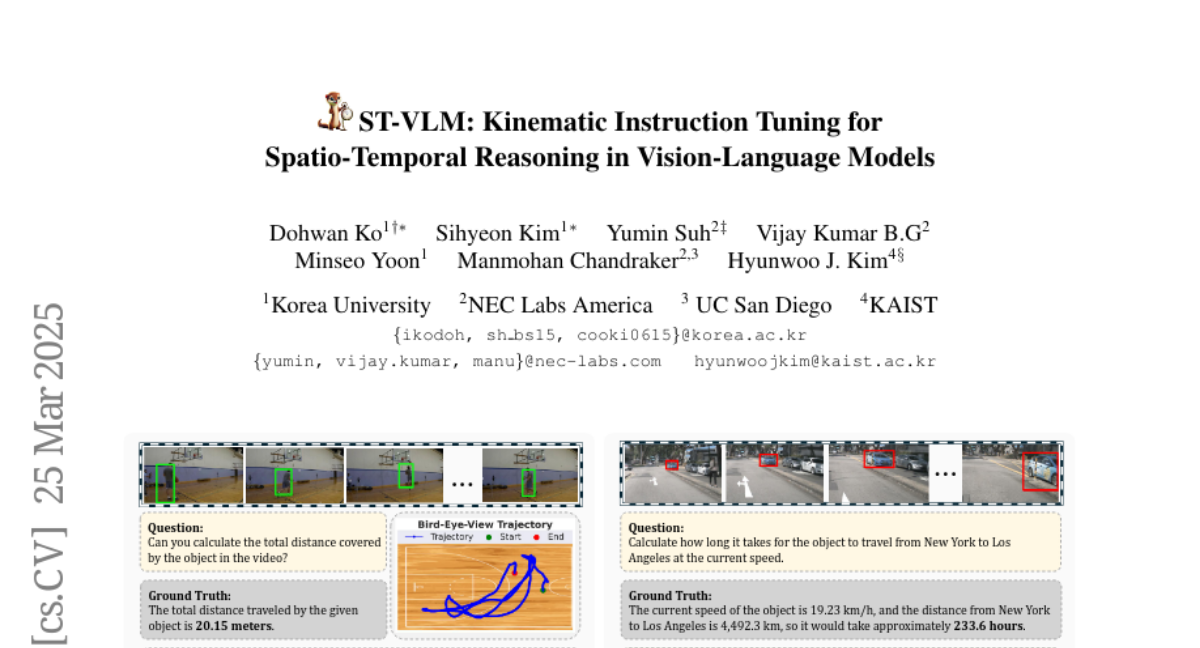
This paper is about teaching AI models to understand how objects move in videos, like how far they travel and how fast they're going.
What's the problem?
AI models that can understand both images and language struggle with understanding movement in videos, which is important for things like self-driving cars and sports analysis.
What's the solution?
The researchers created a new dataset and training method to help AI models learn to understand movement in videos, making them better at tasks that require this kind of understanding.
Why it matters?
This work matters because it can improve AI's ability to understand and interact with the real world, especially in situations that involve moving objects.
Abstract
Spatio-temporal reasoning is essential in understanding real-world environments in various fields, eg, autonomous driving and sports analytics. Recent advances have improved the spatial reasoning ability of Vision-Language Models (VLMs) by introducing large-scale data, but these models still struggle to analyze kinematic elements like traveled distance and speed of moving objects. To bridge this gap, we construct a spatio-temporal reasoning dataset and benchmark involving kinematic instruction tuning, referred to as STKit and STKit-Bench. They consist of real-world videos with 3D annotations, detailing object motion dynamics: traveled distance, speed, movement direction, inter-object distance comparisons, and relative movement direction. To further scale such data construction to videos without 3D labels, we propose an automatic pipeline to generate pseudo-labels using 4D reconstruction in real-world scale. With our kinematic instruction tuning data for spatio-temporal reasoning, we present ST-VLM, a VLM enhanced for spatio-temporal reasoning, which exhibits outstanding performance on STKit-Bench. Furthermore, we show that ST-VLM generalizes robustly across diverse domains and tasks, outperforming baselines on other spatio-temporal benchmarks (eg, ActivityNet, TVQA+). Finally, by integrating learned spatio-temporal reasoning with existing abilities, ST-VLM enables complex multi-step reasoning. Project page: https://ikodoh.github.io/ST-VLM.