STAR-R1: Spatial TrAnsformation Reasoning by Reinforcing Multimodal LLMs
Zongzhao Li, Zongyang Ma, Mingze Li, Songyou Li, Yu Rong, Tingyang Xu, Ziqi Zhang, Deli Zhao, Wenbing Huang
2025-05-27
Summary
This paper talks about STAR-R1, a new training method that helps AI models get better at understanding and reasoning about space and how things move or change position, especially when the models work with both images and text. The method uses reinforcement learning with a detailed reward system to teach the models more effectively.
What's the problem?
The problem is that current training methods for large language models, especially those that handle both pictures and words, aren't very good at teaching the models how to reason about space, like figuring out how objects move or relate to each other. Traditional methods either give feedback that's too general or too rare, so the models don't learn these skills well.
What's the solution?
The authors created STAR-R1, which uses reinforcement learning with a fine-grained reward system. This means the model gets more specific and frequent feedback as it learns, helping it improve its spatial reasoning abilities much more than older training methods.
Why it matters?
This is important because better spatial reasoning in AI can lead to smarter robots, improved navigation systems, and more helpful digital assistants that can understand and interact with the world in ways that are closer to how humans do.
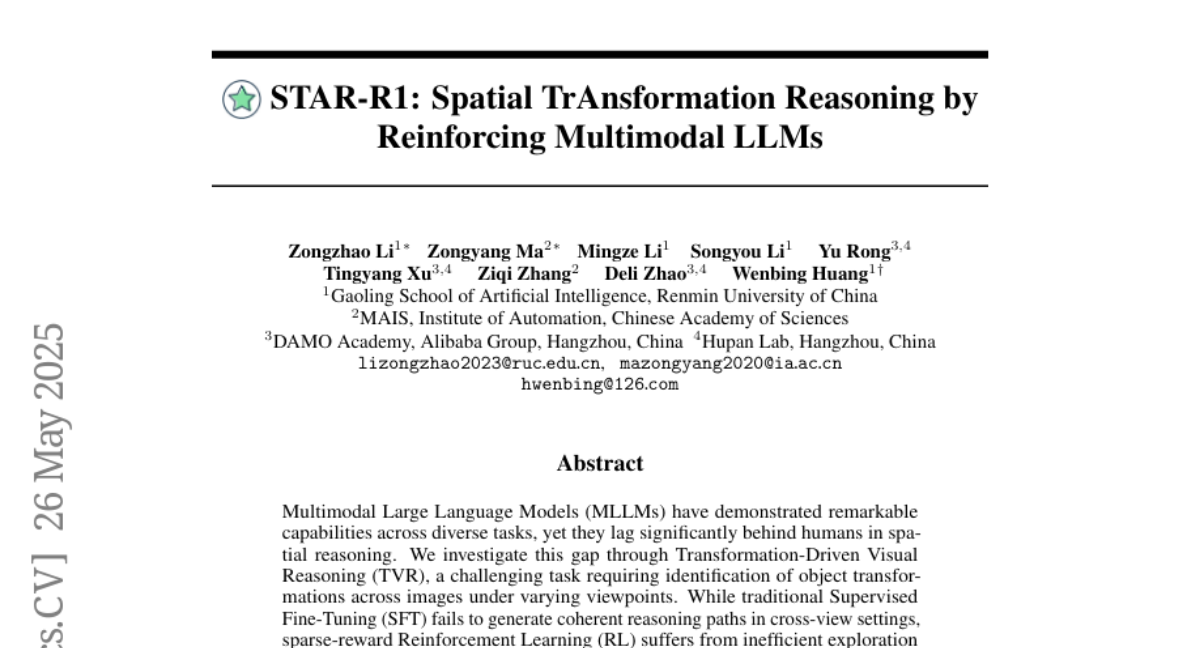
Abstract
STAR-R1, a novel RL framework with a fine-grained reward mechanism, enhances spatial reasoning in multimodal large language models by addressing limitations in traditional SFT and sparse-reward RL.