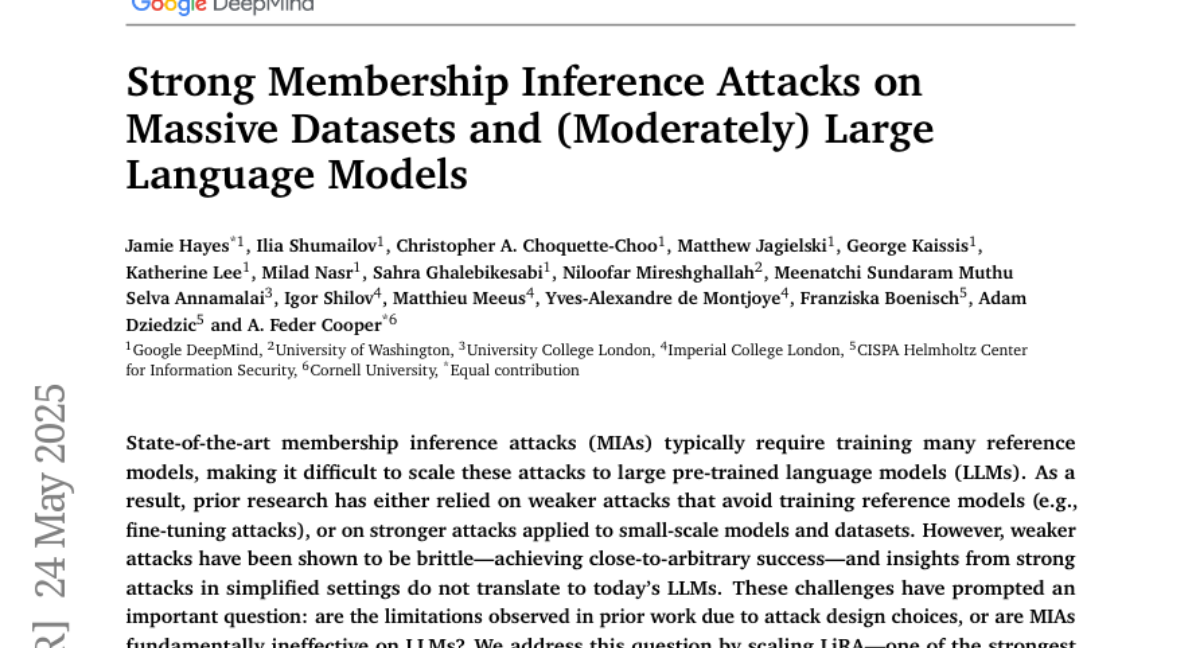
Strong Membership Inference Attacks on Massive Datasets and (Moderately) Large Language Models
Jamie Hayes, Ilia Shumailov, Christopher A. Choquette-Choo, Matthew Jagielski, George Kaissis, Katherine Lee, Milad Nasr, Sahra Ghalebikesabi, Niloofar Mireshghallah, Meenatchi Sundaram Mutu Selva Annamalai, Igor Shilov, Matthieu Meeus, Yves-Alexandre de Montjoye, Franziska Boenisch, Adam Dziedzic, A. Feder Cooper
2025-05-27
Summary
This paper talks about how membership inference attacks, which are ways to figure out if a specific piece of data was used to train a large language model, work when used on really big datasets and fairly large models. The researchers tested how effective these attacks are and whether they can actually break the privacy of these powerful AI systems.
What's the problem?
The problem is that if someone can tell whether a certain example was in the training data of a language model, it could lead to privacy issues, especially if the data is sensitive, like personal information or private messages. People want to know if these attacks are a real threat to big language models or if the models are safe.
What's the solution?
The authors scaled up a type of attack called LiRA to work on much larger datasets and bigger language models than before. They found that while these attacks can sometimes succeed, they are not as effective as people feared. The success of the attack doesn't always match up with the usual ways researchers measure privacy, and often the attack is barely better than just guessing.
Why it matters?
This is important because it shows that, for now, large language models trained on huge datasets are not as easy to attack with membership inference as some might have worried. This means these models might be safer for handling private data, but it's still important to keep looking for new risks and ways to protect privacy.
Abstract
Scaling LiRA membership inference attacks to large pre-trained language models shows that while these attacks can succeed, their effectiveness is limited and does not definitively correlate with privacy metrics.