TaxoAdapt: Aligning LLM-Based Multidimensional Taxonomy Construction to Evolving Research Corpora
Priyanka Kargupta, Nan Zhang, Yunyi Zhang, Rui Zhang, Prasenjit Mitra, Jiawei Han
2025-06-15
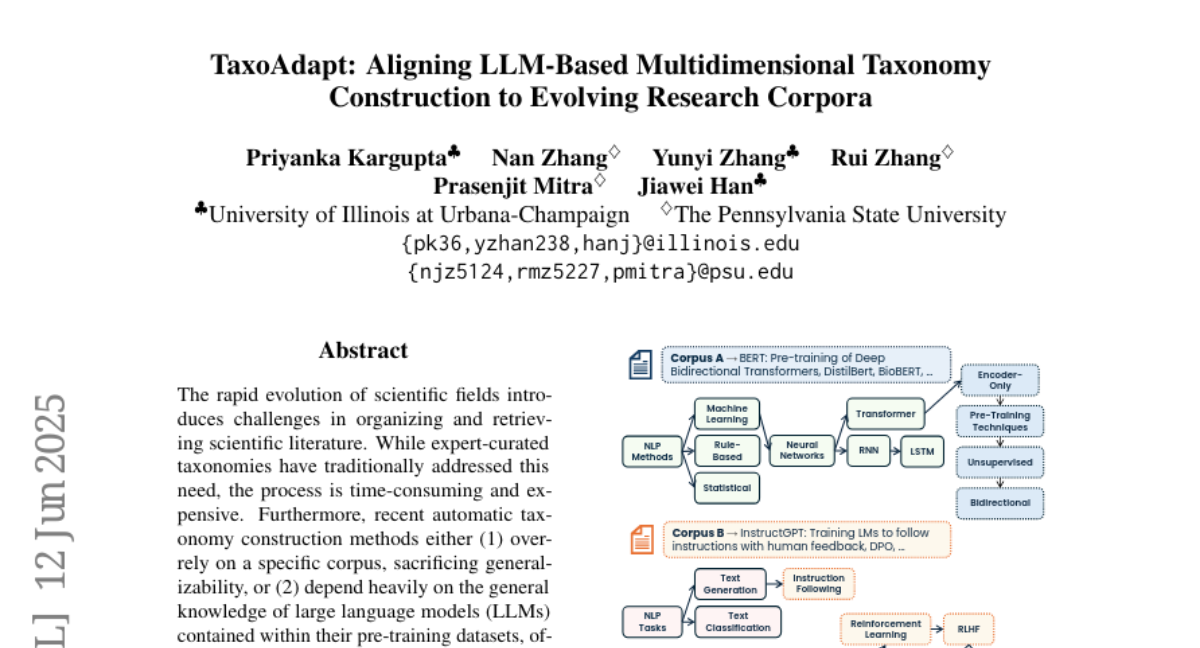
Summary
This paper talks about TaxoAdapt, a system that uses large language models to create and update organized structures called taxonomies for scientific research papers. It groups papers by different important aspects like tasks, methods, or datasets and changes these groups as the research field evolves, making the classification more detailed and clearer than previous methods.
What's the problem?
The problem is that scientific research changes quickly with new ideas and topics appearing all the time, so manually organizing papers is slow and often outdated. Existing automated methods either focus too narrowly on certain papers or depend only on language models' general knowledge, which misses new trends and the many ways papers can be connected.
What's the solution?
The solution was to develop TaxoAdapt, which starts with a basic taxonomy generated by a language model and then improves it by analyzing the actual scientific papers from multiple angles. It repeatedly groups and classifies papers into more specific and meaningful categories, making the taxonomy deeper and broader as needed, using smart techniques to keep the taxonomy clear and structured.
Why it matters?
This matters because having an up-to-date and well-organized map of scientific research helps scientists, students, and readers find relevant papers faster and understand how a field is growing and changing. TaxoAdapt supports better discovery and understanding of knowledge in fast-moving areas by making the organization of research more accurate and flexible.
Abstract
TaxoAdapt dynamically adapts an LLM-generated taxonomy for scientific literature across multiple dimensions, improving granularity and coherence compared to existing methods.