Teaching Large Language Models to Maintain Contextual Faithfulness via Synthetic Tasks and Reinforcement Learning
Shuzheng Si, Haozhe Zhao, Cheng Gao, Yuzhuo Bai, Zhitong Wang, Bofei Gao, Kangyang Luo, Wenhao Li, Yufei Huang, Gang Chen, Fanchao Qi, Minjia Zhang, Baobao Chang, Maosong Sun
2025-05-26
Summary
This paper talks about CANOE, a new way to train large language models so they stick more closely to the information they're given, making their answers more trustworthy and accurate.
What's the problem?
The problem is that language models often make things up or ignore the information in the context they're supposed to use, which is called a lack of faithfulness. This is a big issue for tasks where it's important to give reliable answers, and it's hard to fix because getting enough labeled training data for every situation is expensive and time-consuming.
What's the solution?
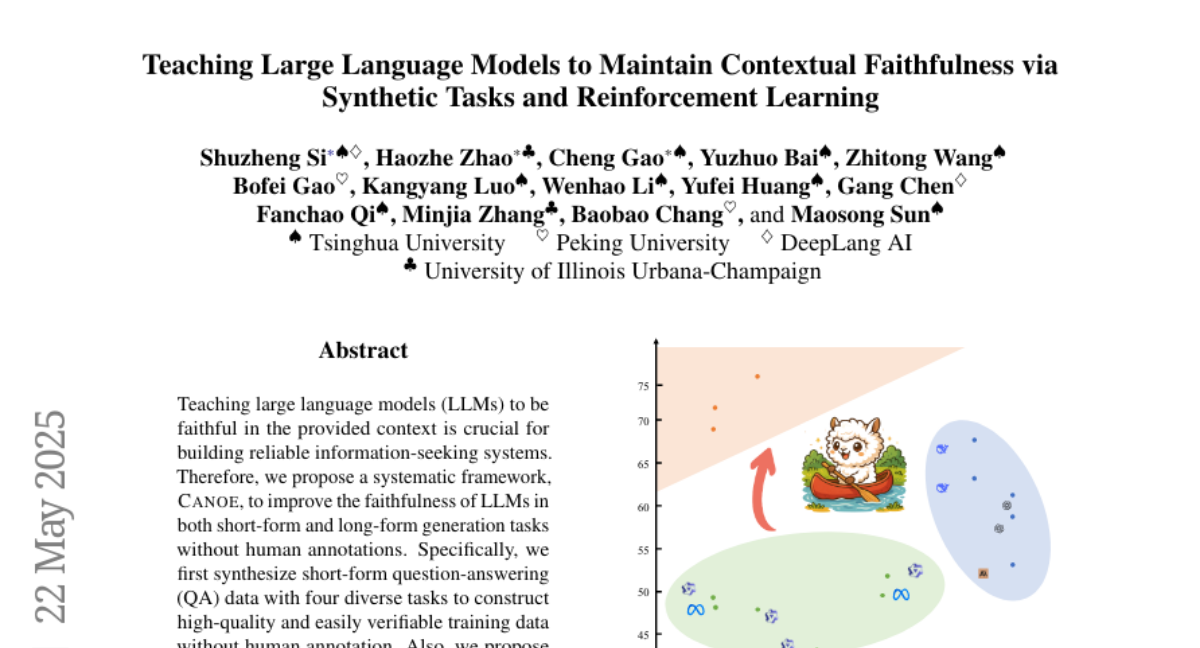
The researchers created CANOE, which generates its own high-quality question-answer data using different types of challenges, like making the model reason or spot false information. Then, they train the language model using a special type of reinforcement learning that rewards it for being accurate, faithful to the context, and well-structured, all without needing humans to label the data.
Why it matters?
This is important because it makes language models much more reliable and accurate across many different tasks, even beating some of the best models out there, and it does this without needing tons of expensive human-labeled data.
Abstract
CANOE improves LLM faithfulness in generation tasks using synthetic QA data and Dual-GRPO reinforcement learning without human annotations.