Teaching Models to Understand (but not Generate) High-risk Data
Ryan Wang, Matthew Finlayson, Luca Soldaini, Swabha Swayamdipta, Robin Jia
2025-05-07
Summary
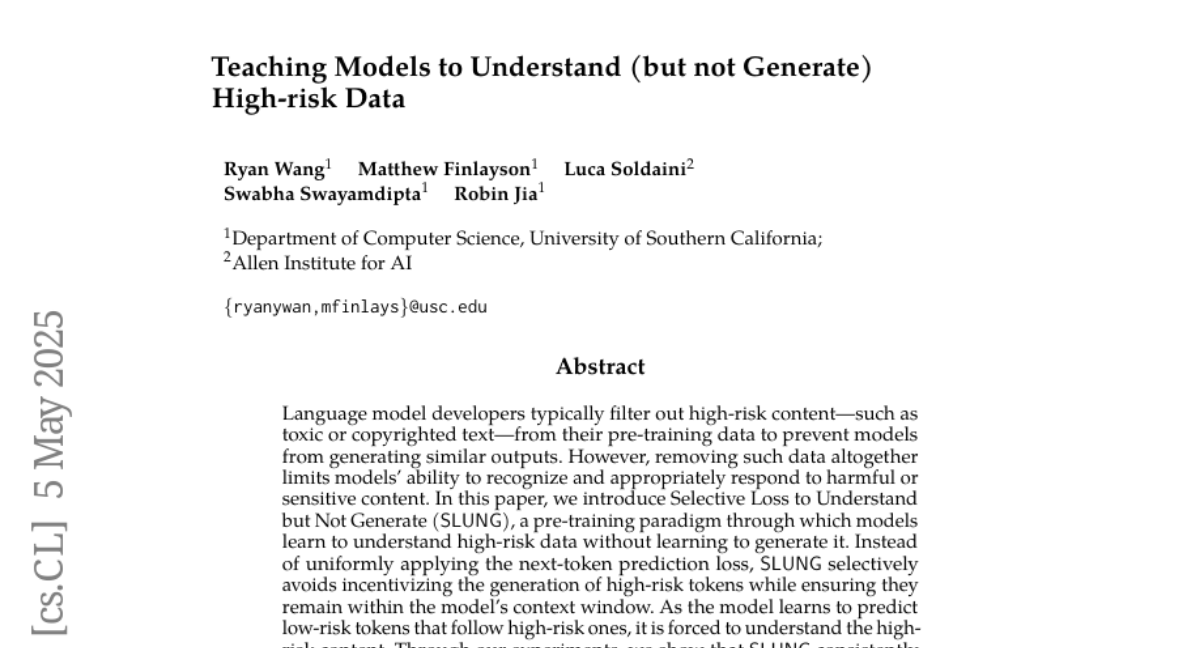
This paper talks about a new way to train AI models so they can understand risky or sensitive content, like harmful or dangerous information, without actually being able to create or generate that kind of content themselves.
What's the problem?
The problem is that while it's useful for AI to recognize and understand high-risk content, we don't want these models to accidentally or intentionally generate or spread it. Traditional training methods often teach models both to understand and to generate content, which can be risky when dealing with sensitive topics.
What's the solution?
The researchers introduce something called the SLUNG paradigm, which is a special way of training AI models. With this approach, the models learn to recognize and understand high-risk content, but they are specifically prevented from generating it. This helps the models become better at identifying dangerous or sensitive information without the risk of them producing it themselves.
Why it matters?
This matters because it makes AI safer to use, especially in situations where it's important to spot harmful content but not create it. By separating understanding from generation, the SLUNG paradigm helps prevent the misuse of AI while still allowing it to be helpful in detecting and managing risky information.
Abstract
The SLUNG paradigm allows models to understand high-risk content without generating it, enhancing their ability to recognize such content while preventing its generation.