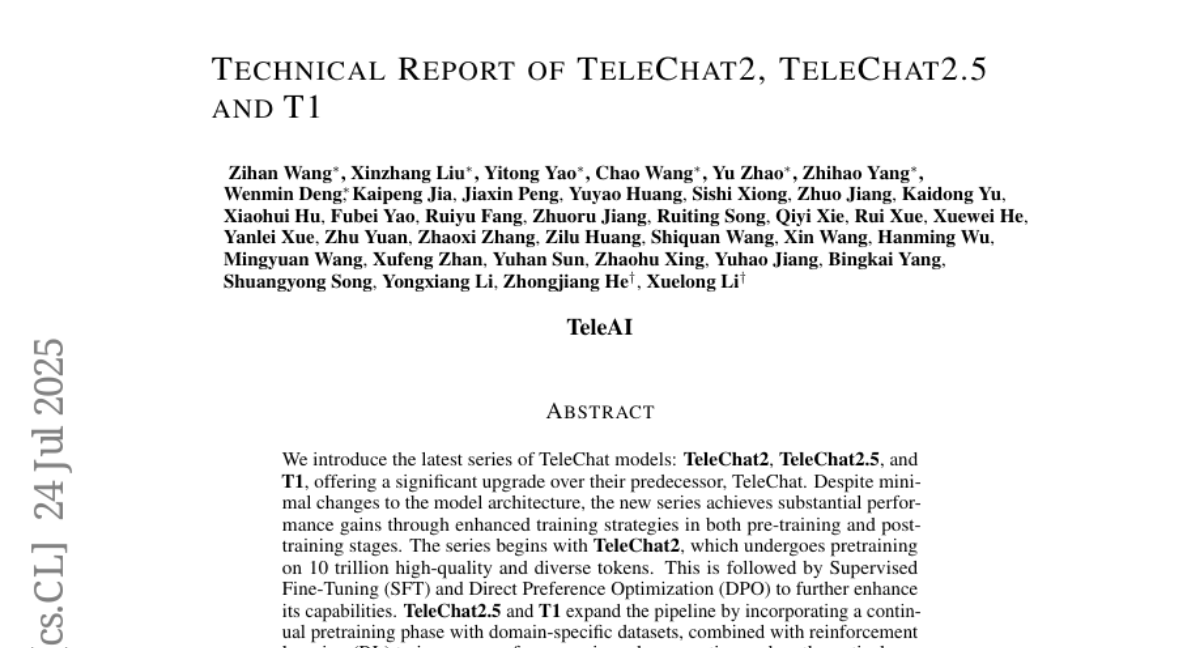
Technical Report of TeleChat2, TeleChat2.5 and T1
Zihan Wang, Xinzhang Liu, Yitong Yao, Chao Wang, Yu Zhao, Zhihao Yang, Wenmin Deng, Kaipeng Jia, Jiaxin Peng, Yuyao Huang, Sishi Xiong, Zhuo Jiang, Kaidong Yu, Xiaohui Hu, Fubei Yao, Ruiyu Fang, Zhuoru Jiang, Ruiting Song, Qiyi Xie, Rui Xue, Xuewei He, Yanlei Xue
2025-07-25
Summary
This paper talks about the TeleChat2, TeleChat2.5, and T1 models, which are advanced large language models that improve performance through better training methods. TeleChat2 is the base model, TeleChat2.5 focuses on making responses faster, and T1 is designed for solving complex reasoning problems.
What's the problem?
Previous models had limitations in understanding long contexts, reasoning deeply, and responding quickly in real-world applications like coding or math challenges.
What's the solution?
The researchers improved training by using massive datasets, supervised fine-tuning, direct preference optimization, and reinforcement learning. TeleChat2.5 adds continual training with specific data and focuses on fast inference, while T1 is optimized for long, step-by-step thinking and complex problem solving.
Why it matters?
This matters because these models offer better reasoning, speed, and adaptability, outperforming well-known models like GPT-4o and helping developers create smarter applications in areas like coding, math, and natural language understanding.
Abstract
The TeleChat2, TeleChat2.5, and T1 models achieve performance improvements through enhanced training strategies, including Supervised Fine-Tuning, Direct Preference Optimization, and reinforcement learning, with T1 focusing on complex reasoning and TeleChat2.5 on speed.