Technologies on Effectiveness and Efficiency: A Survey of State Spaces Models
Xingtai Lv, Youbang Sun, Kaiyan Zhang, Shang Qu, Xuekai Zhu, Yuchen Fan, Yi Wu, Ermo Hua, Xinwei Long, Ning Ding, Bowen Zhou
2025-03-17
Summary
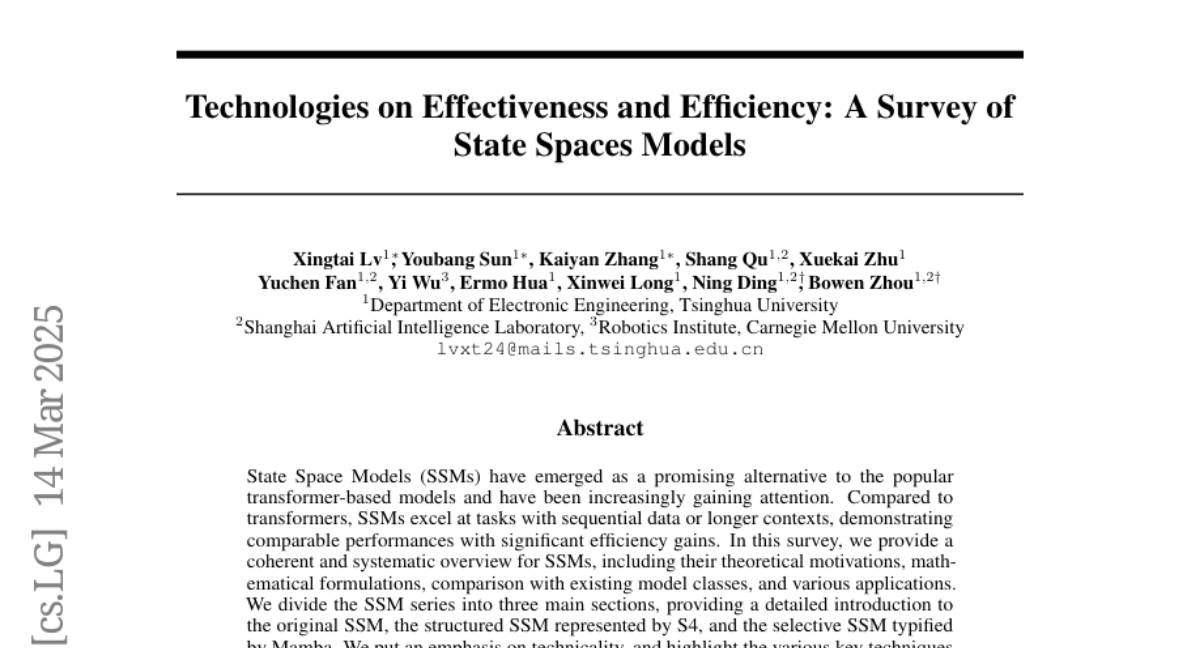
This paper provides an overview of State Space Models (SSMs), which are emerging as a potentially better alternative to the popular transformer models used in AI.
What's the problem?
Transformer models, while powerful, can be inefficient for tasks involving sequential data or long contexts. This means they might struggle with things like understanding long conversations or analyzing time-series data.
What's the solution?
The survey explores SSMs, explaining their theory, math, and how they compare to other models. It focuses on the key techniques that make SSMs effective and efficient, dividing them into three main categories: original SSMs, structured SSMs (like S4), and selective SSMs (like Mamba).
Why it matters?
This work matters because it introduces researchers to a promising new type of AI model that could be more efficient and effective for certain tasks than traditional transformers. This could lead to faster and better AI systems in the future.
Abstract
State Space Models (SSMs) have emerged as a promising alternative to the popular transformer-based models and have been increasingly gaining attention. Compared to transformers, SSMs excel at tasks with sequential data or longer contexts, demonstrating comparable performances with significant efficiency gains. In this survey, we provide a coherent and systematic overview for SSMs, including their theoretical motivations, mathematical formulations, comparison with existing model classes, and various applications. We divide the SSM series into three main sections, providing a detailed introduction to the original SSM, the structured SSM represented by S4, and the selective SSM typified by Mamba. We put an emphasis on technicality, and highlight the various key techniques introduced to address the effectiveness and efficiency of SSMs. We hope this manuscript serves as an introduction for researchers to explore the theoretical foundations of SSMs.