Test3R: Learning to Reconstruct 3D at Test Time
Yuheng Yuan, Qiuhong Shen, Shizun Wang, Xingyi Yang, Xinchao Wang
2025-06-17
Summary
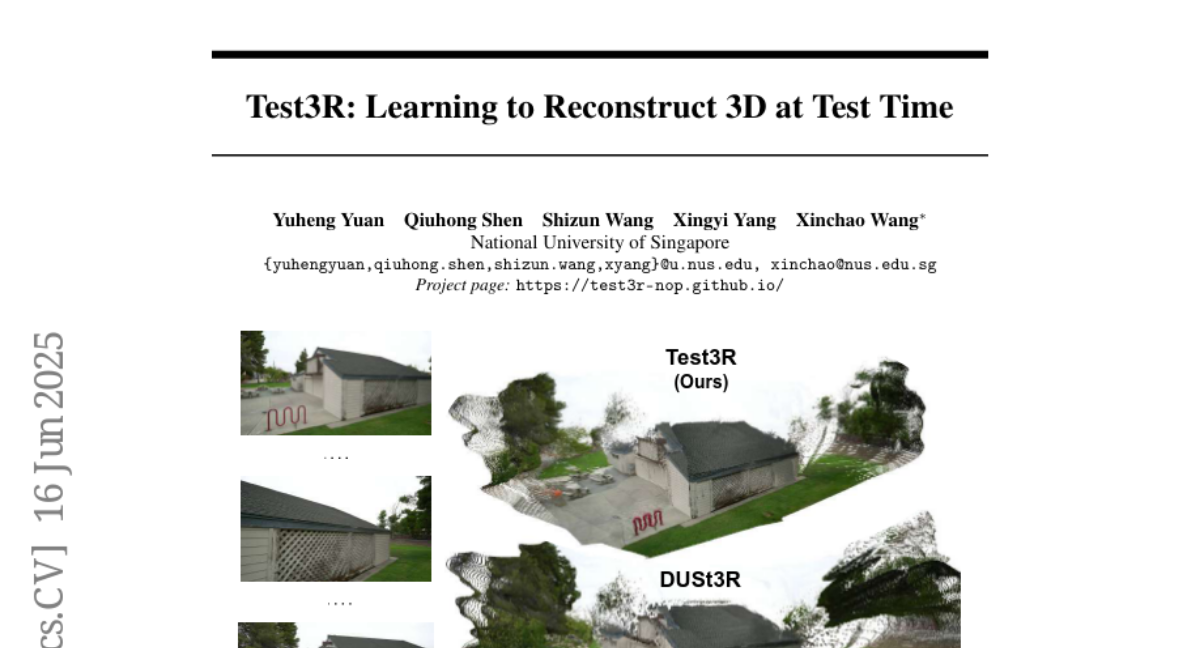
This paper talks about Test3R, a new technique for 3D reconstruction that happens while the model is being tested, not just during training. It improves the accuracy of building 3D shapes from images by using a smart self-checking method that compares two 3D predictions made from three different images, making sure they agree with each other to be more precise.
What's the problem?
The problem is that many current 3D reconstruction methods rely on comparing pairs of images, which can lead to inconsistent and less accurate 3D results, especially when the model tries to work with new or unseen scenes. These methods often produce errors or conflicting 3D shapes because they don't consider global consistency across multiple views, limiting their effectiveness.
What's the solution?
The solution Test3R offers is to learn and adjust the model during testing by enforcing consistency between 3D reconstructions formed from image triplets. It optimizes a self-supervised objective that makes two 3D point maps from different image pairs align closely when viewed from the same reference image. This test-time learning uses a lightweight approach called visual prompt tuning, which improves predictions without needing full retraining, adapting the model quickly to each new scene.
Why it matters?
This matters because it helps create more accurate and reliable 3D models from images, especially when dealing with new and complex scenes. Improving 3D reconstruction in this way supports applications in areas like robotics, augmented reality, and computer vision, where understanding the 3D structure of the environment is crucial. Test3R also makes the process efficient and adaptable, making advanced 3D reconstruction more practical for real-world use.
Abstract
Test3R, a test-time learning technique for 3D reconstruction, enhances geometric accuracy by optimizing network consistency using self-supervised learning on image triplets.