The Imitation Game: Turing Machine Imitator is Length Generalizable Reasoner
Zhouqi Hua, Wenwei Zhang, Chengqi Lyu, Yuzhe Gu, Songyang Gao, Kuikun Liu, Kai Chen
2025-07-18
Summary
This paper talks about TAIL, a new method that trains large language models to mimic how a Turing Machine solves problems step-by-step, which helps them handle much longer and more complex problems better than before.
What's the problem?
The problem is that many large language models struggle to solve tasks with very long sequences or steps because they tend to take shortcuts, which leads to mistakes and limits their ability to reason deeply.
What's the solution?
The authors created synthetic training data that imitates the detailed execution process of a Turing Machine, breaking down problems into tiny, simple steps and including a memory mechanism. This helps the model learn to follow reasoning in a clear, linear way without skipping important steps.
Why it matters?
This matters because it improves how AI can reason and solve difficult problems requiring long sequences of thought, potentially leading to smarter and more reliable AI systems for tasks like math, programming, and complex decision-making.
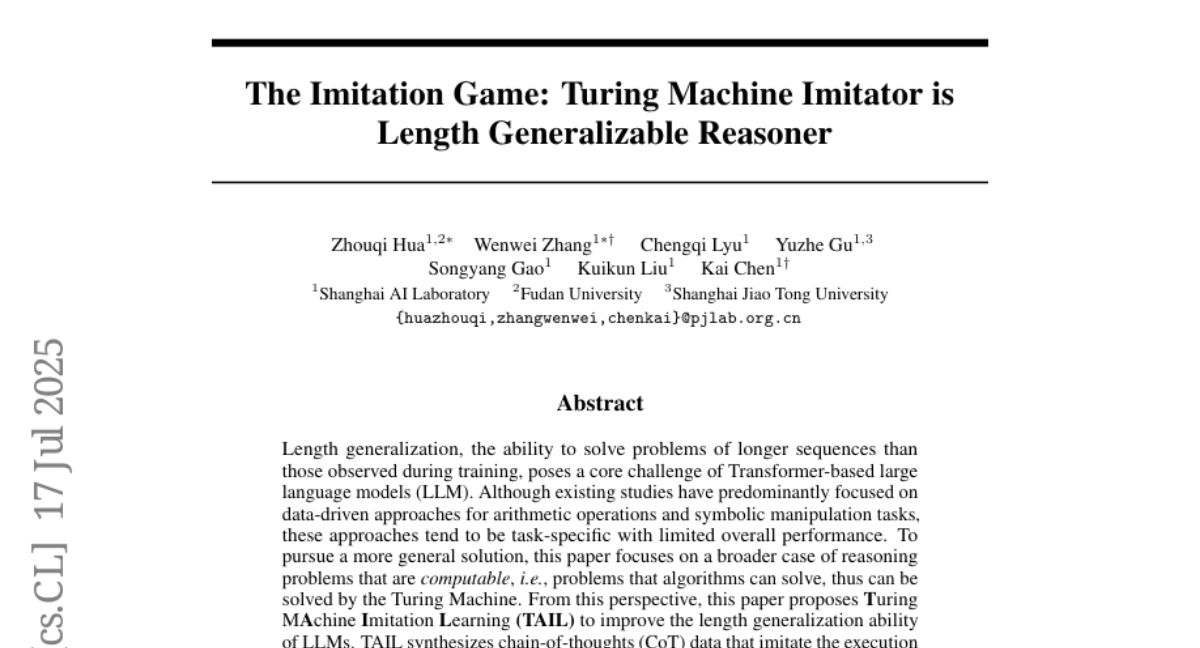
Abstract
TAIL, a method that imitates Turing Machine execution processes, enhances the length generalization and performance of LLMs by synthesizing chain-of-thought data and reducing shortcut learning.