The Open Source Advantage in Large Language Models (LLMs)
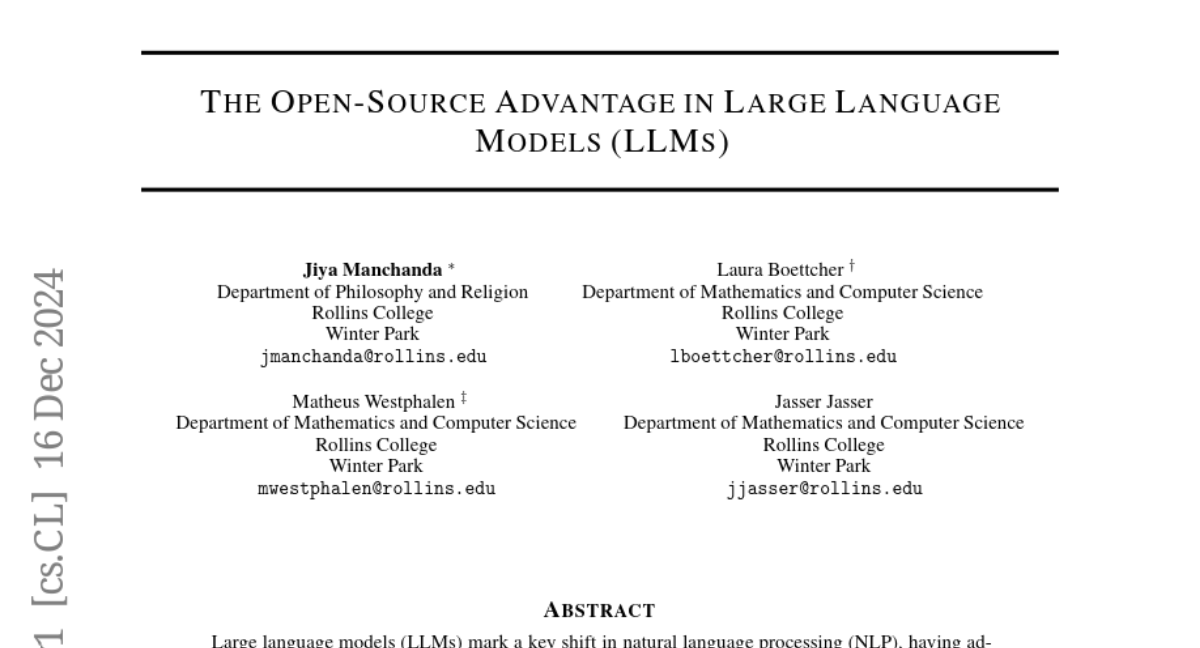
Jiya Manchanda, Laura Boettcher, Matheus Westphalen, Jasser Jasser
2024-12-17
Summary
This paper discusses the advantages of open-source large language models (LLMs) compared to closed-source models, highlighting how open-source initiatives promote accessibility, collaboration, and innovation in artificial intelligence.
What's the problem?
Closed-source LLMs, like GPT-4, are powerful but come with limitations. They are often seen as 'black boxes' because their inner workings are not transparent, making it hard for others to understand or replicate their results. This lack of accessibility can hinder fair development and limit the ability of researchers and developers to improve upon these models.
What's the solution?
Open-source LLMs, such as LLaMA and BLOOM, aim to make AI technology more accessible by allowing anyone to view, modify, and use the model. These models encourage community collaboration and innovation, enabling developers to customize them for specific tasks or languages. Techniques like Low-Rank Adaptation (LoRA) help these models perform well even with fewer resources. The paper emphasizes that while closed-source models excel in scaling up, open-source models adapt better to diverse applications and languages.
Why it matters?
This discussion is important because it highlights the ongoing debate between transparency and proprietary control in AI. Open-source models can lead to more ethical and equitable AI development by allowing wider access and fostering collaboration. As AI continues to evolve, finding a balance between the strengths of both open-source and closed-source approaches will be crucial for future advancements in technology.
Abstract
Large language models (LLMs) mark a key shift in natural language processing (NLP), having advanced text generation, translation, and domain-specific reasoning. Closed-source models like GPT-4, powered by proprietary datasets and extensive computational resources, lead with state-of-the-art performance today. However, they face criticism for their "black box" nature and for limiting accessibility in a manner that hinders reproducibility and equitable AI development. By contrast, open-source initiatives like LLaMA and BLOOM prioritize democratization through community-driven development and computational efficiency. These models have significantly reduced performance gaps, particularly in linguistic diversity and domain-specific applications, while providing accessible tools for global researchers and developers. Notably, both paradigms rely on foundational architectural innovations, such as the Transformer framework by Vaswani et al. (2017). Closed-source models excel by scaling effectively, while open-source models adapt to real-world applications in underrepresented languages and domains. Techniques like Low-Rank Adaptation (LoRA) and instruction-tuning datasets enable open-source models to achieve competitive results despite limited resources. To be sure, the tension between closed-source and open-source approaches underscores a broader debate on transparency versus proprietary control in AI. Ethical considerations further highlight this divide. Closed-source systems restrict external scrutiny, while open-source models promote reproducibility and collaboration but lack standardized auditing documentation frameworks to mitigate biases. Hybrid approaches that leverage the strengths of both paradigms are likely to shape the future of LLM innovation, ensuring accessibility, competitive technical performance, and ethical deployment.