The Serial Scaling Hypothesis
Yuxi Liu, Konpat Preechakul, Kananart Kuwaranancharoen, Yutong Bai
2025-07-22
Summary
This paper talks about the Serial Scaling Hypothesis, which suggests that some important computational problems need step-by-step (serial) processing rather than doing many steps at the same time (parallel), and this idea changes how we should design AI models and computers.
What's the problem?
The problem is that current AI models and hardware focus mostly on parallel processing, which works well for many tasks, but it struggles with tasks that require a sequence of dependent steps, like complex reasoning or planning, where each step builds on the previous one.
What's the solution?
The authors explain through theory and examples that solving these sequential tasks demands scaling up the amount of serial computation—doing more steps one after another. They argue that AI model designs and hardware need to consider this and possibly revisit older or new designs that better support serial, step-by-step processing.
Why it matters?
This matters because as AI tackles harder problems, recognizing the need for serial computation will help create better models and faster, more suitable hardware, enabling more advanced and accurate AI systems for areas like math reasoning, physics, and decision-making.
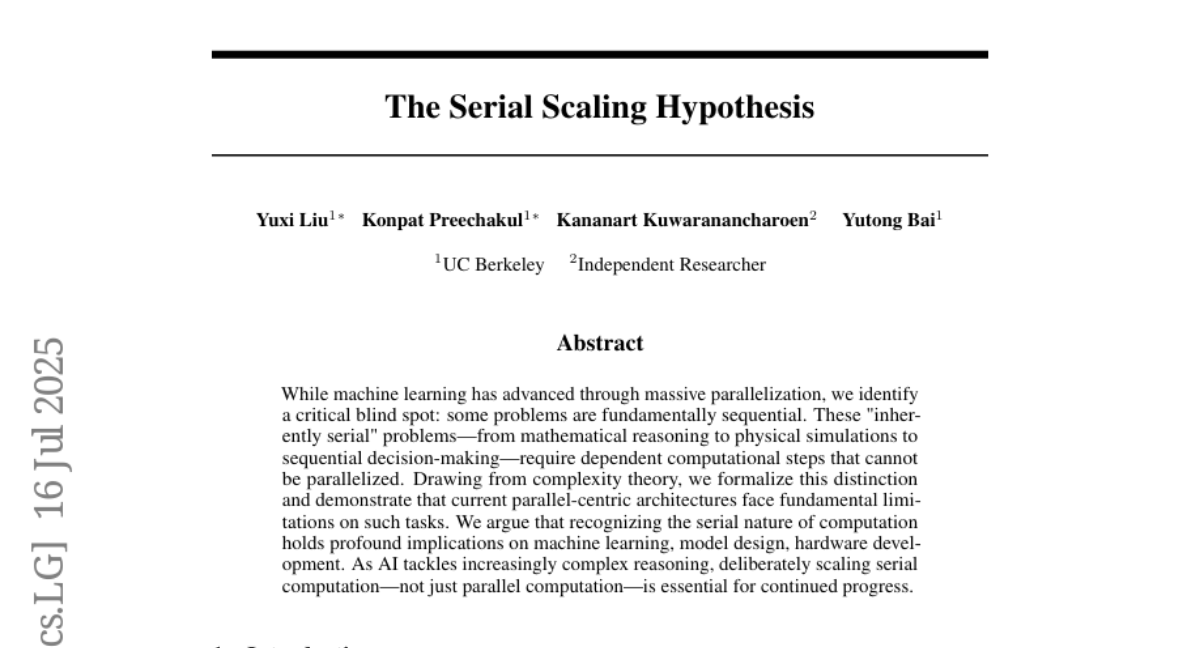
Abstract
Recognizing the inherently serial nature of certain computational tasks is crucial for advancing machine learning and model design, as parallel architectures have limitations in handling such problems.