The Sparse Frontier: Sparse Attention Trade-offs in Transformer LLMs
Piotr Nawrot, Robert Li, Renjie Huang, Sebastian Ruder, Kelly Marchisio, Edoardo M. Ponti
2025-04-28
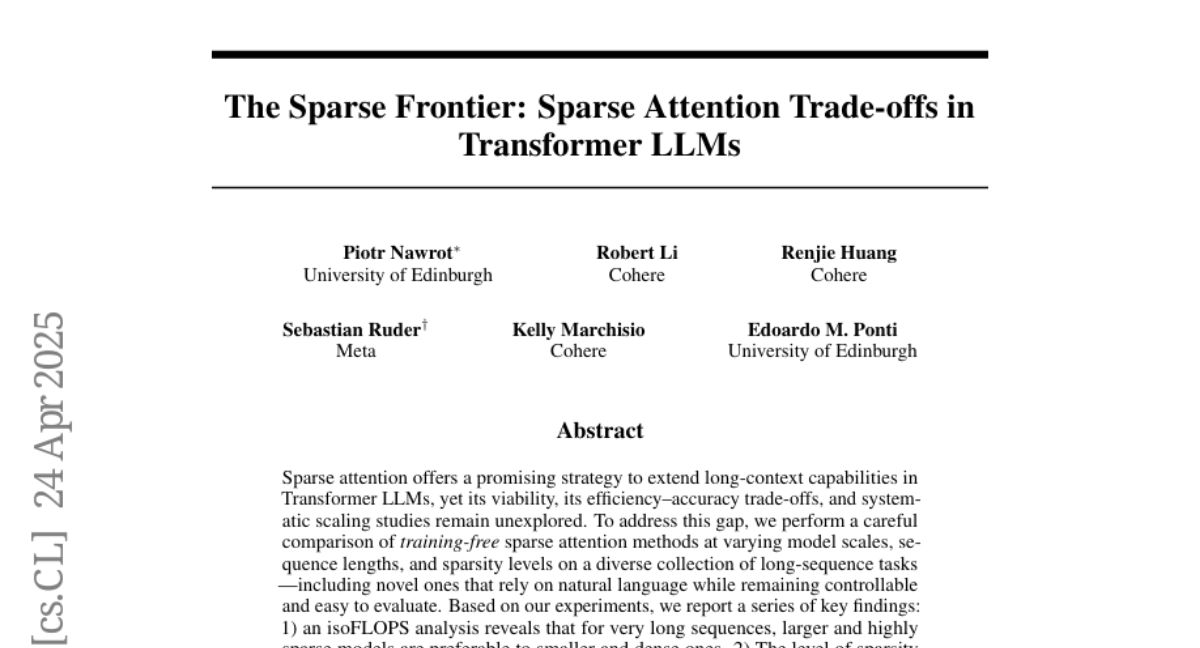
Summary
This paper talks about how using sparse attention methods can help large language models, like Transformers, handle much longer pieces of text without using as much computer power, but with some trade-offs between speed and accuracy.
What's the problem?
The problem is that regular Transformers need a lot of memory and computing power to pay attention to every single word in really long texts, which makes it hard for them to work with big documents or conversations.
What's the solution?
The researchers explored different ways to make the model focus only on the most important parts of the text, instead of everything at once. This approach, called sparse attention, lets the model handle longer texts more efficiently, but depending on how it's done, there can be differences in how fast or accurate the model is for different types of tasks.
Why it matters?
This matters because it helps make powerful language models more practical for real-world uses, like reading books, analyzing long reports, or having extended conversations, all while using less computer power and memory.
Abstract
Sparse attention methods enable extending long-context capabilities in Transformer LLMs with varying efficiency-accuracy trade-offs across different tasks and scales.