Think Twice: Enhancing LLM Reasoning by Scaling Multi-round Test-time Thinking
Xiaoyu Tian, Sitong Zhao, Haotian Wang, Shuaiting Chen, Yunjie Ji, Yiping Peng, Han Zhao, Xiangang Li
2025-03-26
Summary
This paper is about making AI language models better at reasoning by letting them think through a problem multiple times.
What's the problem?
Even the best AI language models can struggle with complex reasoning tasks because they have limitations in how much information they can process at once and how efficiently they learn.
What's the solution?
The researchers developed a simple technique called Multi-round Thinking, where the AI model uses its previous answers as hints to improve its reasoning in the next round. It's like letting the AI double-check its work.
Why it matters?
This work matters because it shows that letting AI models think through problems multiple times can significantly improve their performance on various tasks, making them more reliable and capable problem-solvers.
Abstract
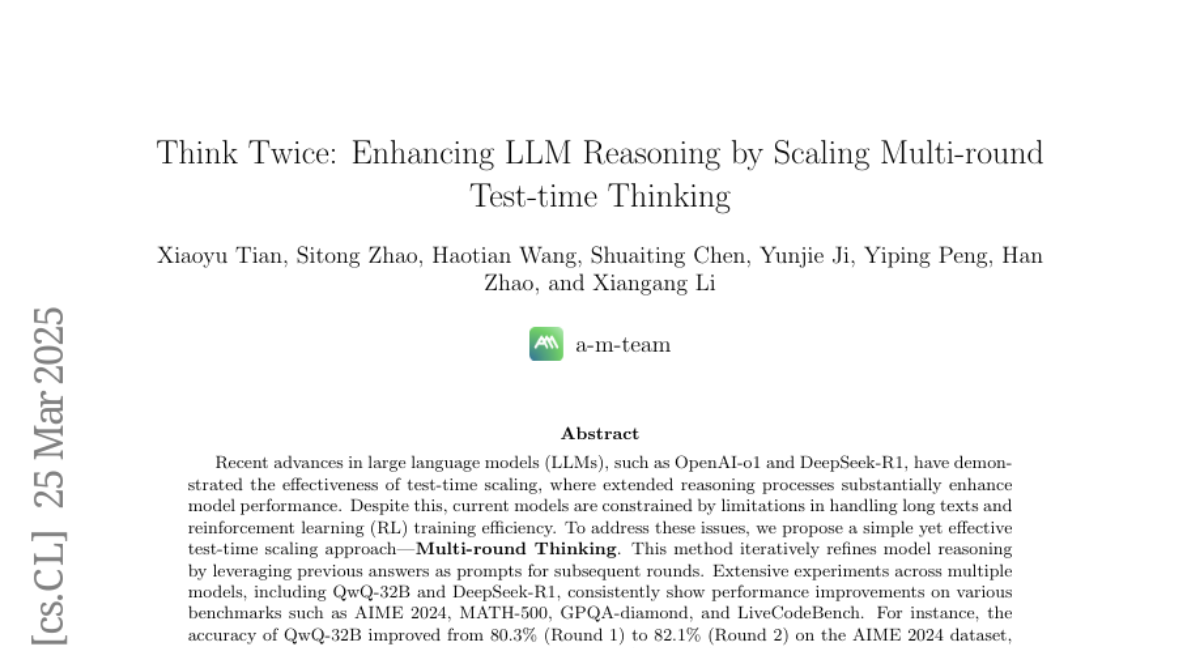
Recent advances in large language models (LLMs), such as OpenAI-o1 and DeepSeek-R1, have demonstrated the effectiveness of test-time scaling, where extended reasoning processes substantially enhance model performance. Despite this, current models are constrained by limitations in handling long texts and reinforcement learning (RL) training efficiency. To address these issues, we propose a simple yet effective test-time scaling approach Multi-round Thinking. This method iteratively refines model reasoning by leveraging previous answers as prompts for subsequent rounds. Extensive experiments across multiple models, including QwQ-32B and DeepSeek-R1, consistently show performance improvements on various benchmarks such as AIME 2024, MATH-500, GPQA-diamond, and LiveCodeBench. For instance, the accuracy of QwQ-32B improved from 80.3% (Round 1) to 82.1% (Round 2) on the AIME 2024 dataset, while DeepSeek-R1 showed a similar increase from 79.7% to 82.0%. These results confirm that Multi-round Thinking is a broadly applicable, straightforward approach to achieving stable enhancements in model performance, underscoring its potential for future developments in test-time scaling techniques. The key prompt: {Original question prompt} The assistant's previous answer is: <answer> {last round answer} </answer>, and please re-answer.