Through the Looking Glass: Common Sense Consistency Evaluation of Weird Images
Elisei Rykov, Kseniia Petrushina, Kseniia Titova, Anton Razzhigaev, Alexander Panchenko, Vasily Konovalov
2025-05-20
Summary
This paper talks about a new way to help computers figure out if strange or weird images actually make sense in the real world, using advanced AI models that understand both pictures and language.
What's the problem?
The problem is that computers often have trouble judging if an unusual image is realistic or fits with what we know about how the world works, especially when the images are odd or unexpected.
What's the solution?
To solve this, the researchers created a method called Through the Looking Glass, which uses powerful vision-language models and special AI tools called Transformer-based encoders to check if these weird images are consistent with common sense. They tested this method on special collections of strange images to see how well it works.
Why it matters?
This matters because teaching computers to understand what makes sense and what doesn't in images can help with things like filtering out fake or misleading pictures online, improving safety, and making AI better at understanding the world like humans do.
Abstract
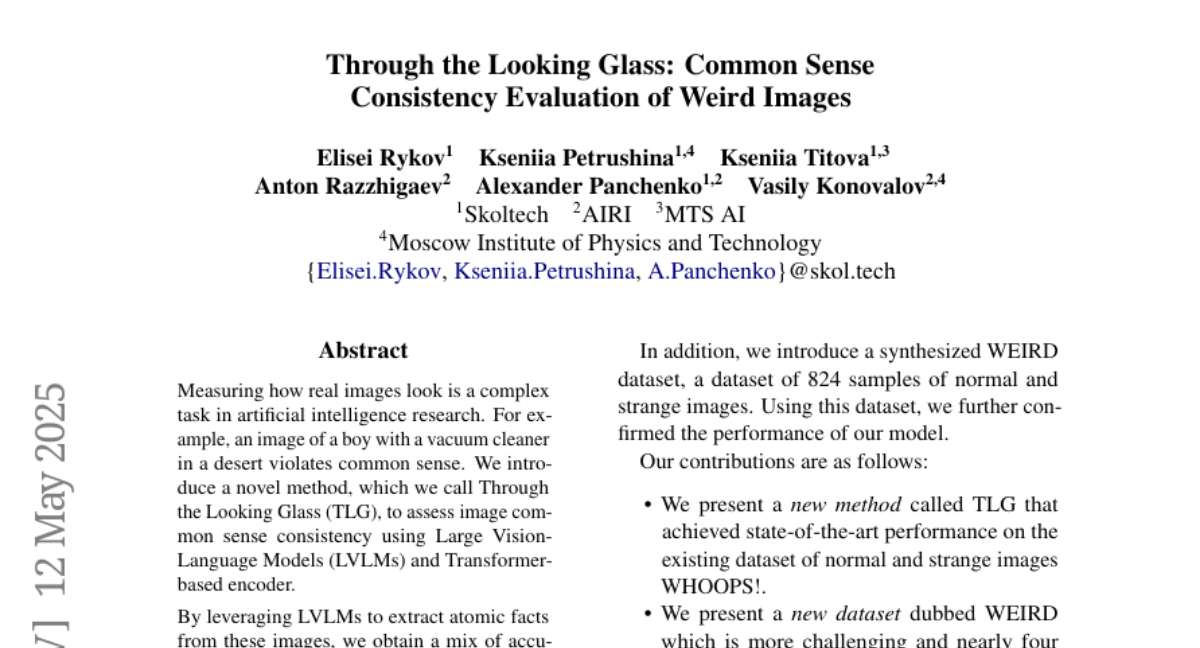
A new method, Through the Looking Glass (TLG), uses Large Vision-Language Models and Transformer-based encoders to improve image common sense consistency assessment on the WHOOPS! and WEIRD datasets.