Time-R1: Towards Comprehensive Temporal Reasoning in LLMs
Zijia Liu, Peixuan Han, Haofei Yu, Haoru Li, Jiaxuan You
2025-05-26
Summary
This paper talks about Time-R1, a new system that helps medium-sized language models get much better at understanding and reasoning about time, like predicting what might happen next or creating stories that make sense over time.
What's the problem?
The problem is that most language models, especially the smaller ones, struggle to handle tasks that require understanding how events happen in order or predicting future events, which limits how useful they are for things like planning or storytelling.
What's the solution?
The researchers developed Time-R1, which uses a special training method called a reinforcement learning curriculum to teach these models how to handle time-related reasoning. This approach helps the models become even better than some larger models at predicting future events and coming up with creative scenarios.
Why it matters?
This is important because it means we can make smaller, more efficient AI models that are still really good at tasks involving time, making them more practical and accessible for things like scheduling, creative writing, and planning.
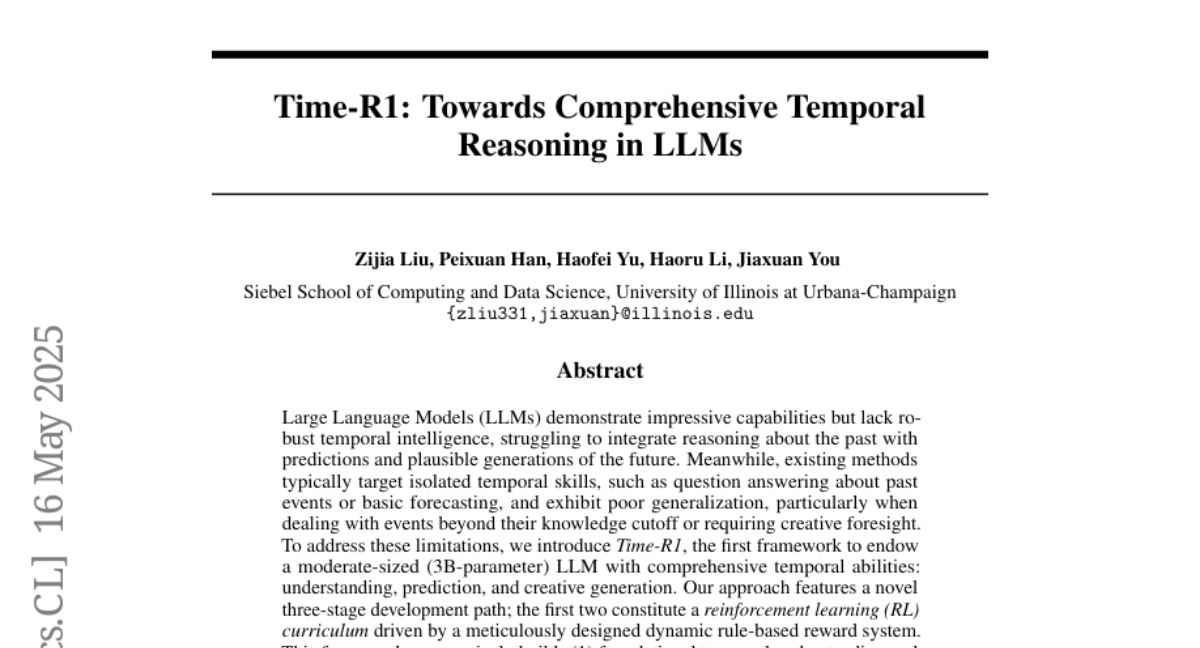
Abstract
A novel framework, Time-R1, enhances moderate-sized LLMs with comprehensive temporal abilities through a reinforcement learning curriculum, outperforming larger models on future event prediction and creative scenario generation benchmarks.