Towards a Unified Copernicus Foundation Model for Earth Vision
Yi Wang, Zhitong Xiong, Chenying Liu, Adam J. Stewart, Thomas Dujardin, Nikolaos Ioannis Bountos, Angelos Zavras, Franziska Gerken, Ioannis Papoutsis, Laura Leal-Taixé, Xiao Xiang Zhu
2025-03-26
Summary
This paper is about creating a powerful AI model that can understand and analyze satellite images of Earth using data from different sources.
What's the problem?
Most AI models for analyzing satellite data only use information from specific sensors or focus on the Earth's surface, missing valuable data about the atmosphere or other sources.
What's the solution?
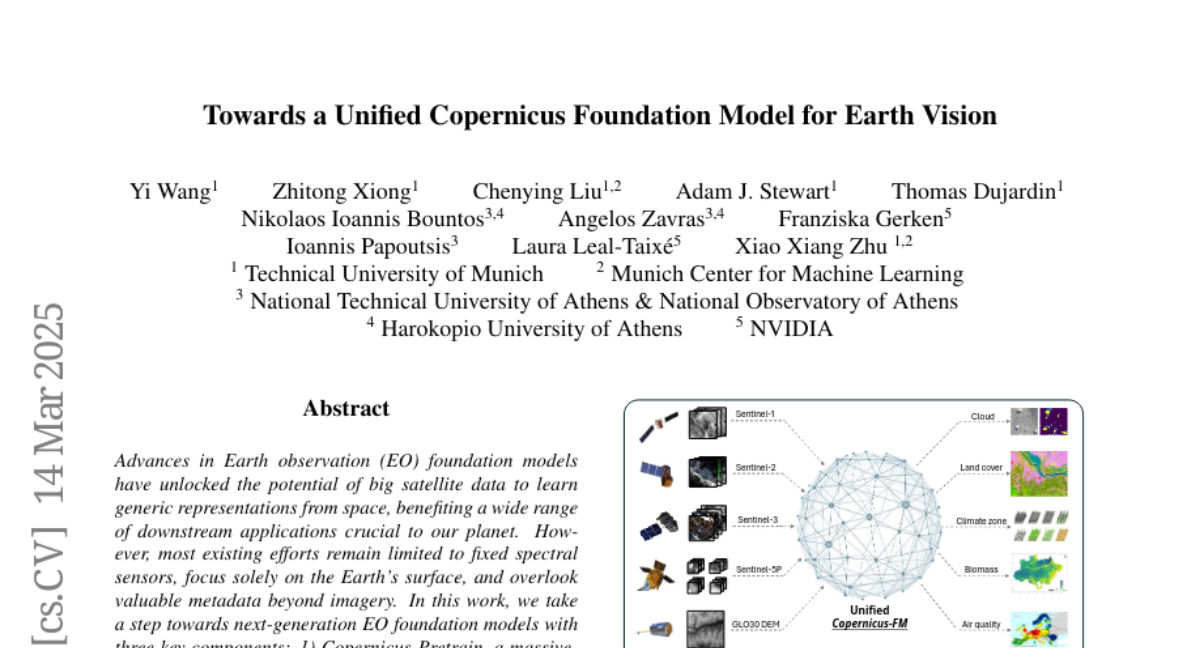
The researchers created a new AI model called Copernicus-FM that can process data from different satellite sensors and other sources, giving it a more complete view of Earth.
Why it matters?
This work matters because it can help us better understand and address environmental challenges, such as climate change, by analyzing satellite data in a more comprehensive way.
Abstract
Advances in Earth observation (EO) foundation models have unlocked the potential of big satellite data to learn generic representations from space, benefiting a wide range of downstream applications crucial to our planet. However, most existing efforts remain limited to fixed spectral sensors, focus solely on the Earth's surface, and overlook valuable metadata beyond imagery. In this work, we take a step towards next-generation EO foundation models with three key components: 1) Copernicus-Pretrain, a massive-scale pretraining dataset that integrates 18.7M aligned images from all major Copernicus Sentinel missions, spanning from the Earth's surface to its atmosphere; 2) Copernicus-FM, a unified foundation model capable of processing any spectral or non-spectral sensor modality using extended dynamic hypernetworks and flexible metadata encoding; and 3) Copernicus-Bench, a systematic evaluation benchmark with 15 hierarchical downstream tasks ranging from preprocessing to specialized applications for each Sentinel mission. Our dataset, model, and benchmark greatly improve the scalability, versatility, and multimodal adaptability of EO foundation models, while also creating new opportunities to connect EO, weather, and climate research. Codes, datasets and models are available at https://github.com/zhu-xlab/Copernicus-FM.