Towards Solving More Challenging IMO Problems via Decoupled Reasoning and Proving
Zhenwen Liang, Linfeng Song, Yang Li, Tao Yang, Feng Zhang, Haitao Mi, Dong Yu
2025-07-10
Summary
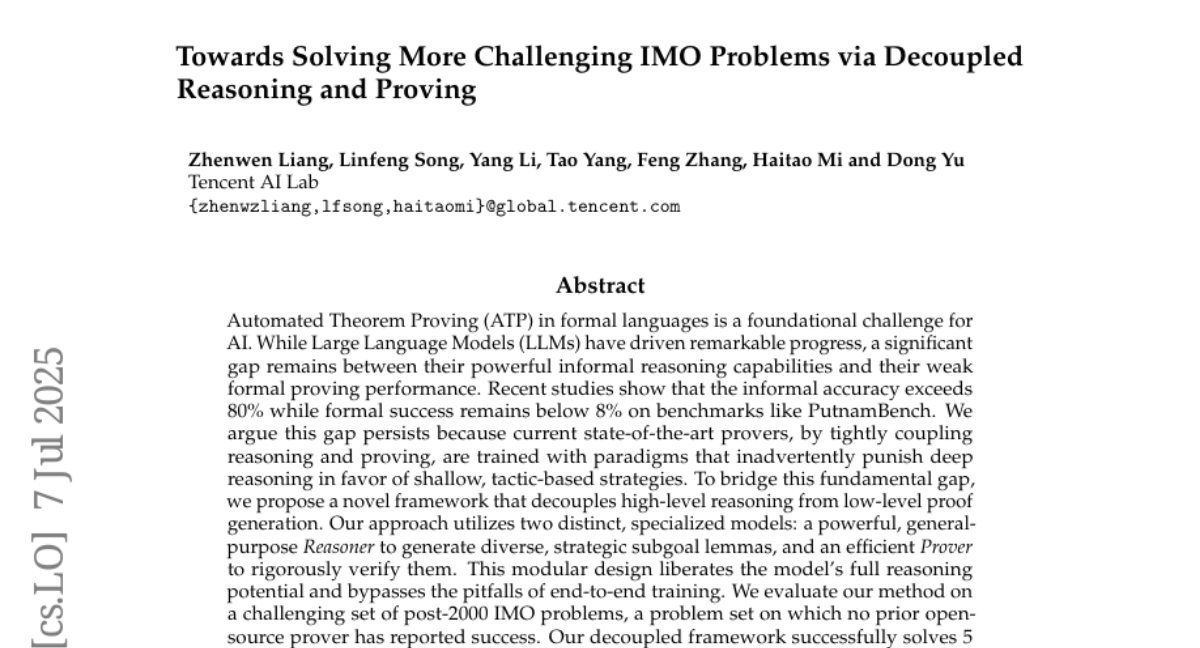
This paper talks about a new system that separates high-level thinking from low-level proof writing to help AI solve really hard math problems like those in the International Math Olympiad (IMO). It uses one model to make smart strategic guesses and another to check if those guesses are correct.
What's the problem?
The problem is that AI models can think about math in an informal way very well, but they struggle to write precise, formal proofs that computers can verify. Current methods try to do both reasoning and proving at the same time, which limits how deep the AI’s thinking can be and lowers success on hard problems.
What's the solution?
The researchers created a framework that splits the task into two parts. A strong reasoning model generates important intermediate steps, or lemmas, that help break down the problem. Then a separate proving model rigorously checks these steps to make sure they are logically correct. This way, the AI can focus fully on smart thinking and careful proof checking separately, improving its overall performance.
Why it matters?
This matters because it helps AI solve very difficult mathematical problems more effectively, which can lead to new discoveries in math and computer science. It also improves how AI can be used for formal verification in software and hardware, making technology safer and more reliable.
Abstract
A novel framework decouples high-level reasoning from low-level proof generation to improve automated theorem proving performance on challenging mathematical problems.