TTRL: Test-Time Reinforcement Learning
Yuxin Zuo, Kaiyan Zhang, Shang Qu, Li Sheng, Xuekai Zhu, Biqing Qi, Youbang Sun, Ganqu Cui, Ning Ding, Bowen Zhou
2025-04-23
Summary
This paper talks about TTRL, a new technique that helps large language models get better at different tasks by learning from new data even when there aren’t any labels or answers provided.
What's the problem?
The problem is that most language models need labeled data, which means someone has to tell the model what the correct answer is for every example. Getting all this labeled data is time-consuming and expensive, and it limits how much the model can improve once it’s already been trained.
What's the solution?
The researchers introduced Test-Time Reinforcement Learning, which lets the language model keep learning and improving while it’s being used, by using reinforcement learning with data that doesn’t have any labels. The model gets feedback based on how well it does, so it can adjust and get better at tasks in real time.
Why it matters?
This matters because it means language models can keep getting smarter and more useful without needing tons of extra labeled data, making them more adaptable and effective for all kinds of real-world uses.
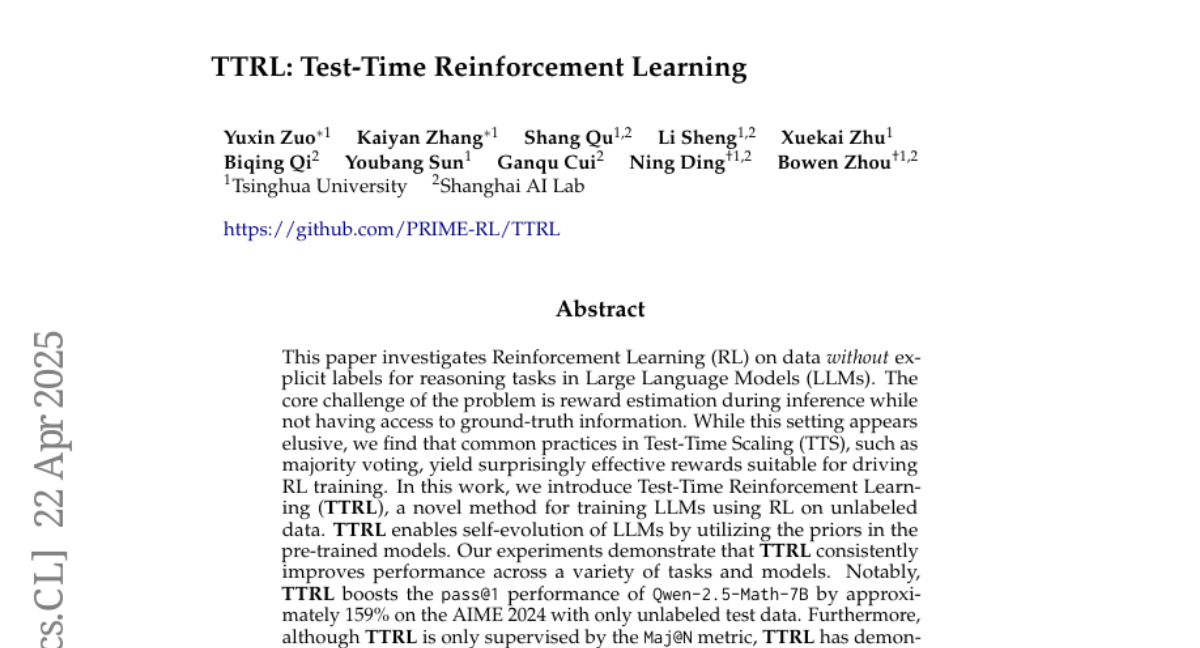
Abstract
Test-Time Reinforcement Learning (TTRL) enhances Large Language Models (LLMs) using unlabeled data through reinforcement learning, improving performance across tasks.