UGPL: Uncertainty-Guided Progressive Learning for Evidence-Based Classification in Computed Tomography
Shravan Venkatraman, Pavan Kumar S, Rakesh Raj Madavan, Chandrakala S
2025-07-22
Summary
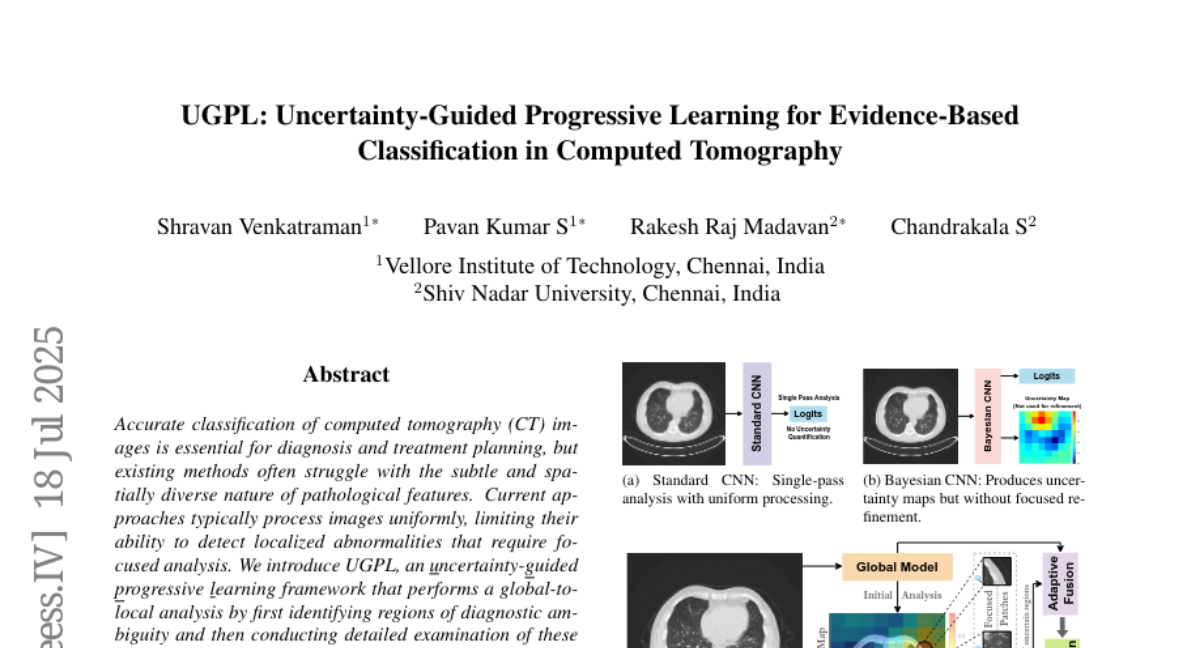
This paper talks about UGPL, a new method for classifying CT scans that uses a two-step process to focus on uncertain and tricky parts of the images for better diagnosis.
What's the problem?
The problem is that existing methods treat all areas of a CT scan the same, which makes it hard to identify subtle abnormalities that need special attention, leading to less accurate medical diagnoses.
What's the solution?
The authors created UGPL, which first analyzes the whole CT image to find areas where the model is unsure, then focuses on those ambiguous regions using a detailed analysis. The final decision combines both broad and focused results to improve accuracy.
Why it matters?
This matters because it helps doctors get more accurate information from CT scans, leading to better diagnoses and treatment plans for diseases like lung cancer, COVID-19, and kidney problems.
Abstract
UGPL, an uncertainty-guided progressive learning framework, enhances CT image classification by focusing on ambiguous regions and integrating contextual and detailed information, outperforming existing methods across various datasets.