UloRL:An Ultra-Long Output Reinforcement Learning Approach for Advancing Large Language Models' Reasoning Abilities
Dong Du, Shulin Liu, Tao Yang, Shaohua Chen, Yang Li
2025-07-29
Summary
This paper talks about UloRL, a new approach that helps large language models think and reason better when they need to produce very long answers or explanations.
What's the problem?
The problem is that when language models try to generate very long responses, they often struggle to keep track of everything or maintain good quality, and training them for long outputs can be slow and difficult.
What's the solution?
UloRL solves this by breaking the long output into smaller segments and training the model on these segments with a technique called dynamic masking, which helps the model focus on important parts during learning. This makes training faster and the model better at handling long, complex reasoning.
Why it matters?
This matters because many real-world problems need detailed explanations or multi-step reasoning, so improving how models handle long outputs makes them much more useful for tasks like writing, problem-solving, and understanding complicated ideas.
Abstract
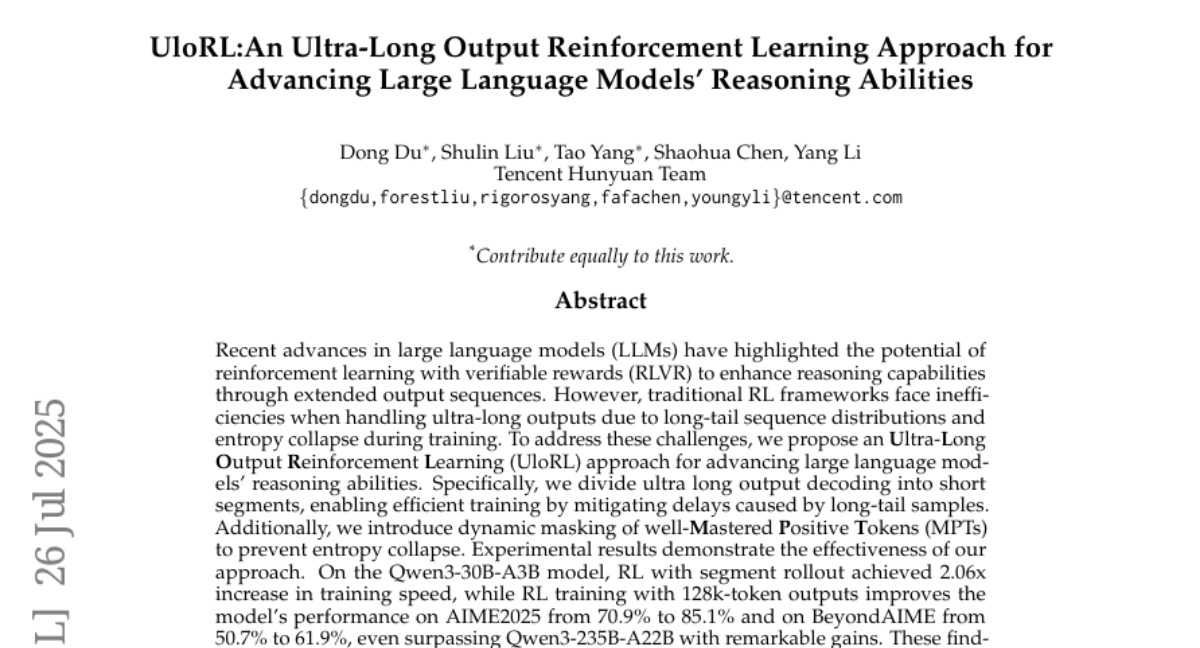
The Ultra-Long Output Reinforcement Learning (UloRL) approach enhances large language models' reasoning by segmenting long outputs and using dynamic masking, leading to improved performance and faster training.